
Selling Data as a Digital Good with Scaling Valuations
Abstract
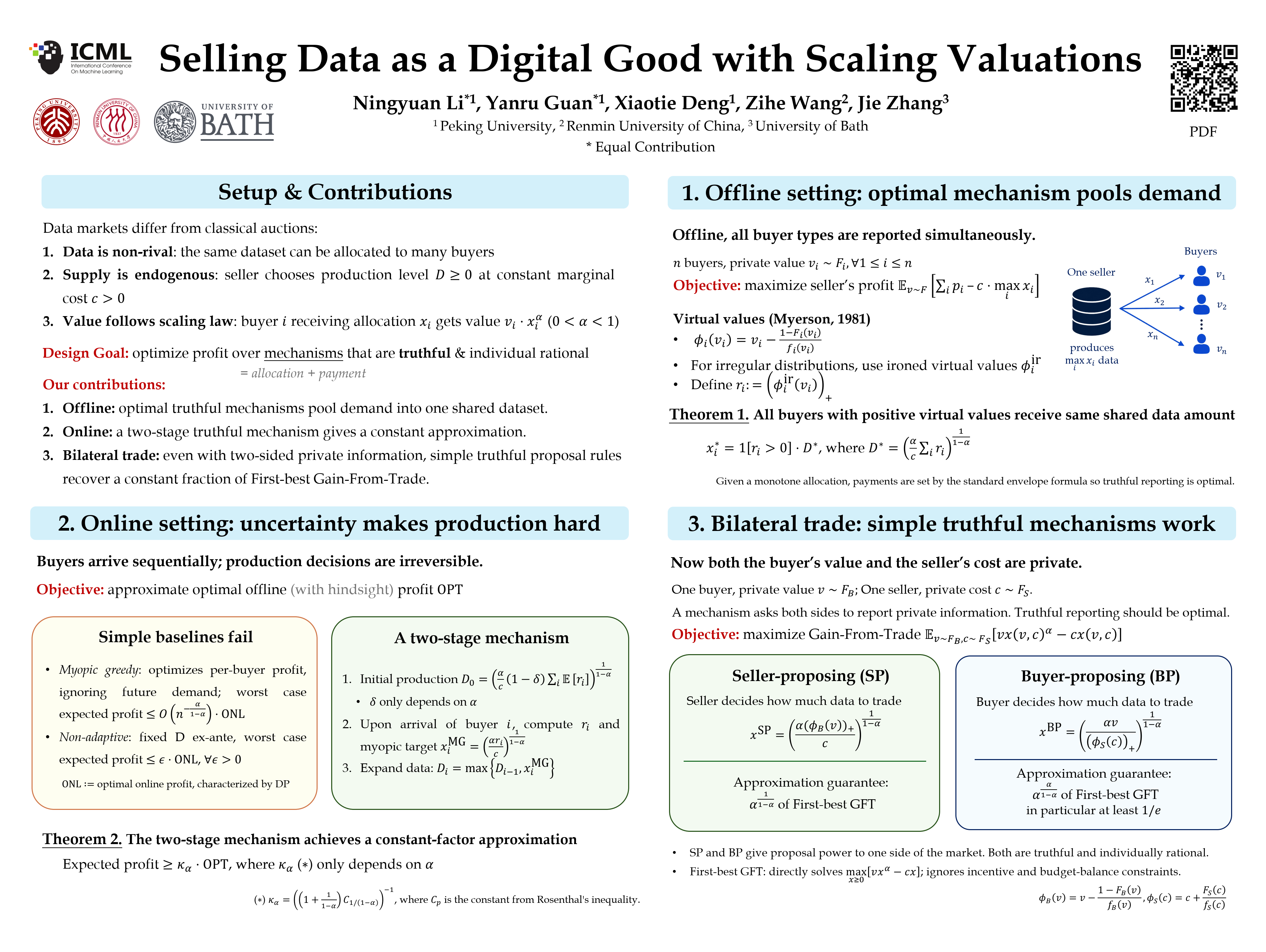
We study mechanism design for selling data as a digital good when the value derived from training AI models follows a scaling law. The seller faces a linear cost when producing data, while the buyers benefit from additional data with diminishing returns as data volume increases. This departs from classical auction models by allowing allocations to be continuous quantities of data rather than binary outcomes. We first analyze an offline setting in which all buyer types are realized simultaneously, characterizing profit-optimal mechanisms and showing how virtual-value methods extend to continuous data allocations. We then consider an online setting with sequential arrivals, where production decisions must be made under demand uncertainty. We show that myopic allocation and fixed production plans can be arbitrarily suboptimal, whereas a simple two-stage algorithm that combines upfront production with adaptive expansion achieves a constant-factor approximation to the offline optimum. Finally, we study bilateral data trading under asymmetric information, where both the buyer’s value and the seller’s cost are private. Although the optimal truthful mechanism has a complex structure, we show that simple and implementable mechanisms recover a constant fraction of the first-best gain-from-trade. Overall, our results highlight how scaling laws introduce new algorithmic trade-offs in market design and provide performance guarantees for data markets under uncertainty.
Lay Summary
Selling data is challenging because, unlike physical goods, data can be freely copied to share among many buyers, and its value in AI training grows more slowly as more is added. This makes it hard for a data seller to decide how much to produce and what price to charge, especially when the demand is uncertain. We designed simple market rules for several common situations. For online settings where many buyers arrive one by one, we created a simple two-stage strategy that first produces an initial amount of data based on expectations, then expands it adaptively. This two-step strategy achieves near-optimal profit. For bilateral trading between one seller and one buyer, we show that letting either side propose a deal can recover most of the potential social welfare. Our work provides practical, provably effective rules for emerging data marketplaces, such as platforms selling AI training data. It shows that even under uncertainty and private information, straightforward mechanisms can achieve near-optimal performance, helping to build more efficient and trustworthy data markets.