
Unbiased and Second-Order-Free Training for High-Dimensional PDEs
Abstract
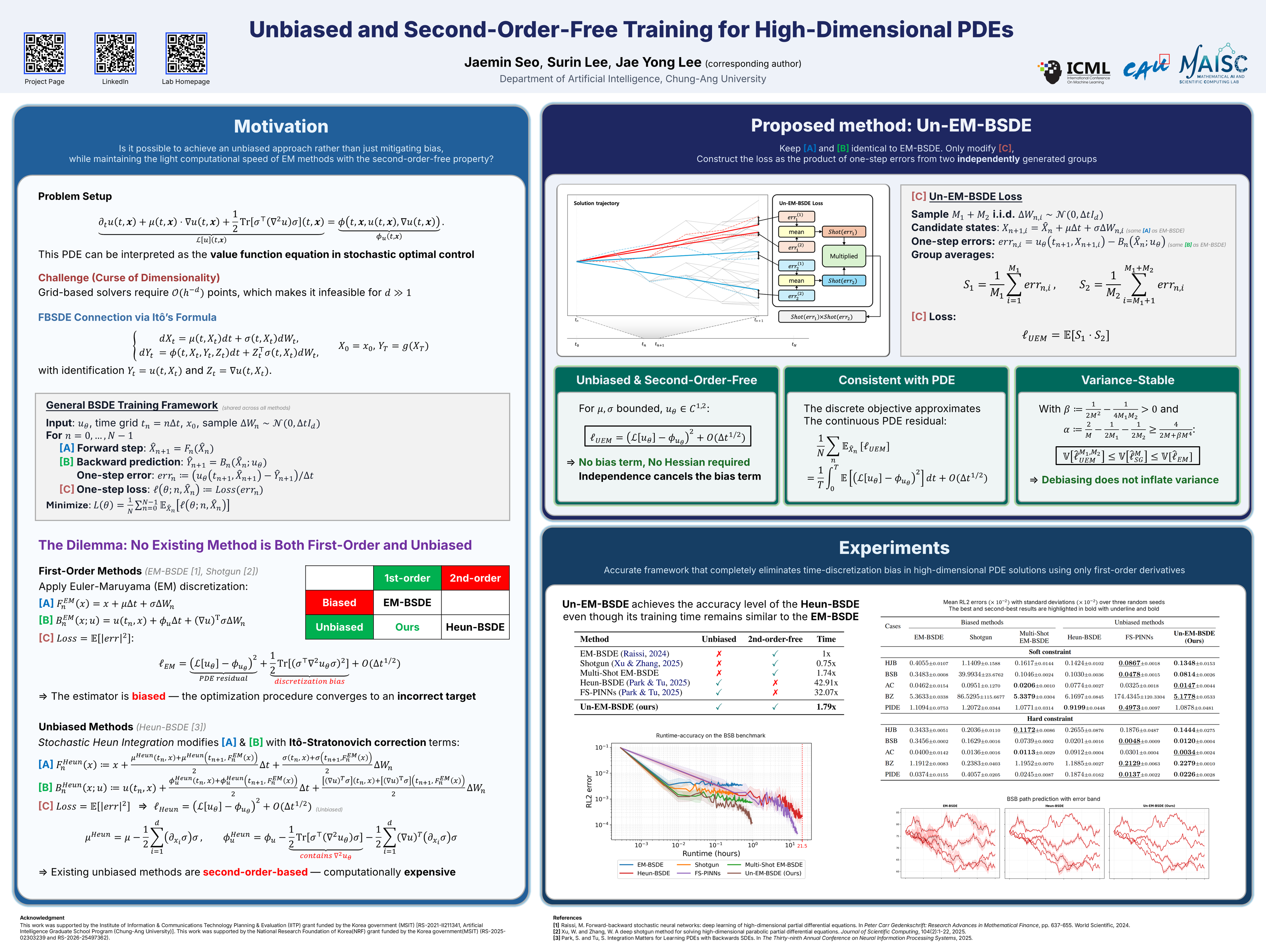
Deep learning methods based on backward stochastic differential equations (BSDEs) have emerged as competitive alternatives to physics-informed neural networks (PINNs) for solving high-dimensional partial differential equations (PDEs). By leveraging probabilistic representations, BSDE approaches can avoid the curse of dimensionality and often admit second-order-free training objectives that do not require explicit Hessian evaluations. It has recently been established that the commonly used Euler–Maruyama (EM) time discretization induces an intrinsic bias in BSDE training losses. While high-order schemes such as Heun can fully eliminate this bias, such schemes re-introduce second-order spatial derivatives and incur substantial computational overhead. In this work, we provide a principled analysis of EM-induced loss bias and propose an unbiased, second-order-free training framework that preserves the computational advantages of BSDE methods. Our code is available at https://github.com/seojaemin22/Un-EM-BSDE.
Lay Summary
Many real-world systems, such as financial markets and physical processes, are modeled by equations that describe change over time. When these systems involve many interacting variables, solving the equations becomes very expensive. Machine learning can help by learning from randomly simulated trajectories, but common fast methods introduce small systematic errors. More accurate methods can avoid these errors, but only with much heavier computations. Our work introduces a training objective that keeps the speed of fast trajectory-based methods while removing their systematic error. It combines two independent estimates of a one-step prediction error so the bias cancels on average without making training unstable. The method avoids expensive second-order derivative calculations and improves accuracy while preserving scalability.