
IO-Adam: Rethinking Memory-Efficient Adaptive Optimizers from Gradient Computation
Abstract
Lay Summary
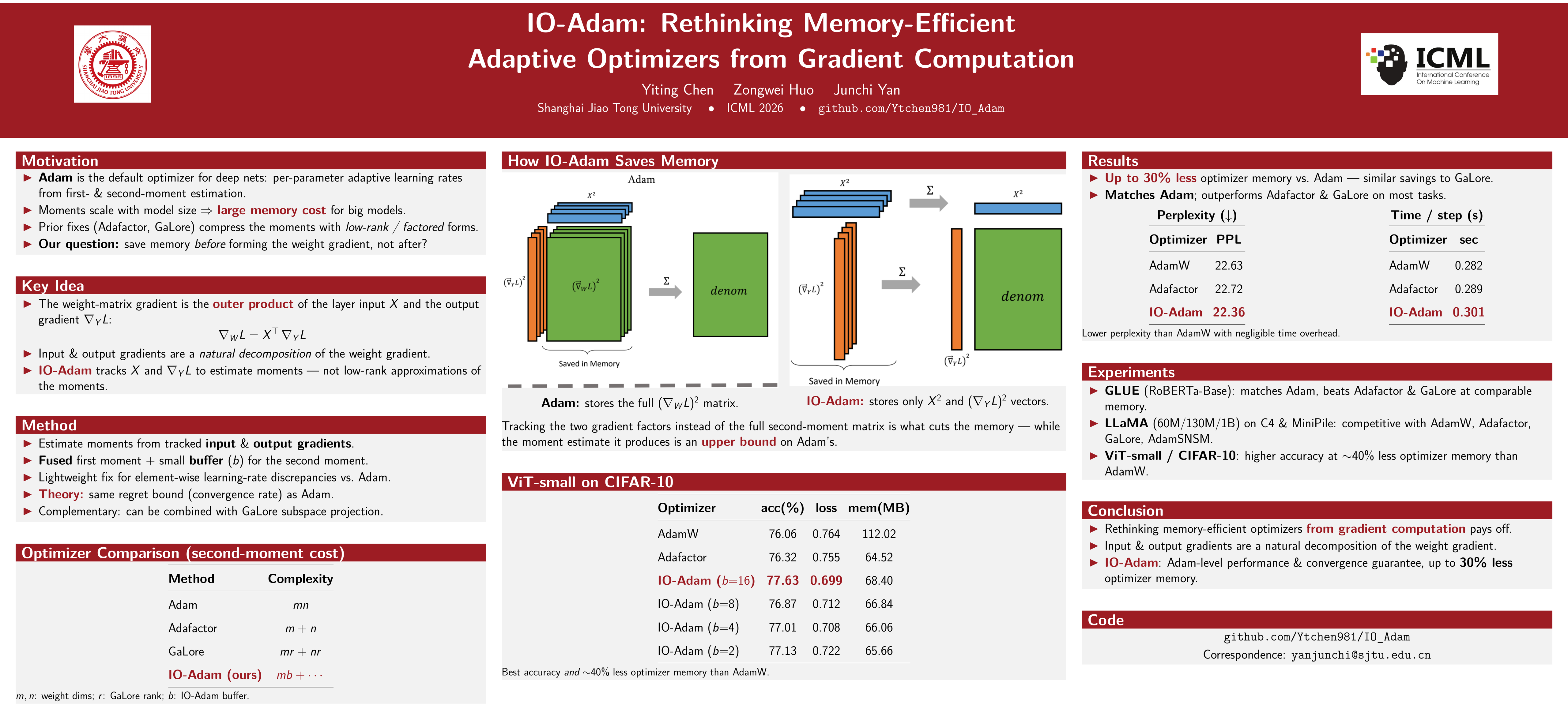
Adaptive optimizers, e.g., Adaptive Moment Estimation (Adam), adjust the learning rate for each parameter for fast convergence. However, these adaptive optimizers often require recording additional information during deep neural network training, e.g., first- and second-moment estimates for Adam, which can significantly increase memory usage. Various methods have been proposed to reduce Adam's memory usage. In this paper, we propose a new method that separately records second-moment estimates for the input and output gradients, thereby reducing memory usage while maintaining similar or even better performance. The gradient—the signal that tells the network how to adjust its weights—can naturally be broken down into two parts: the input entering a layer and the error signal leaving it. Instead of storing the full gradient statistics as Adam does, we store separate, much smaller summaries of the input and the output error.