
Learning to Decode Against Compositional Hallucination in Video Multimodal Large Language Models
Abstract
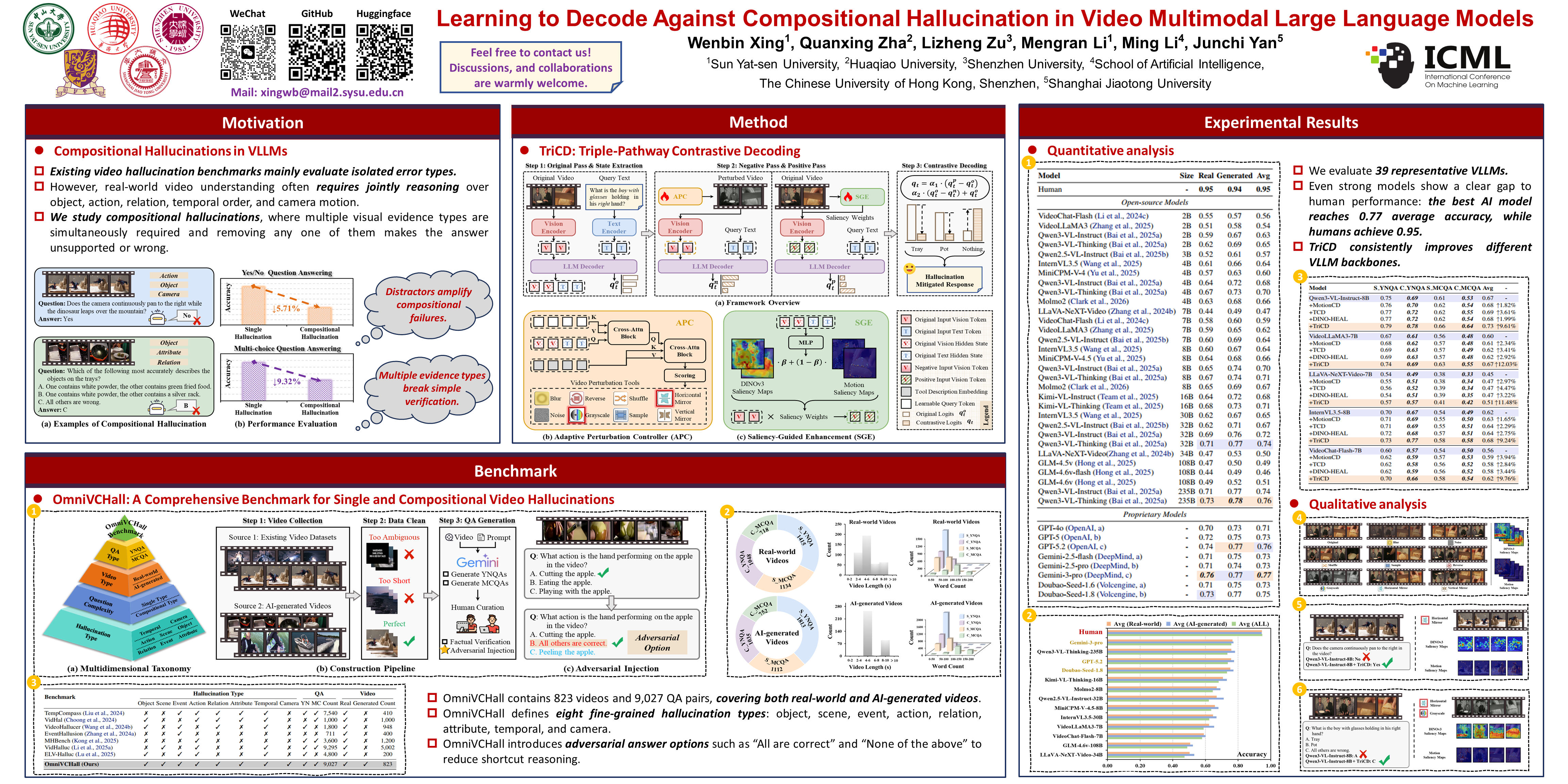
Current research on video hallucination mitigation primarily focuses on isolated error types, leaving compositional hallucinations—arising from incorrect reasoning over multiple interacting spatial and temporal factors largely underexplored. We introduce OmniVCHall, a benchmark designed to systematically evaluate both isolated and compositional hallucinations in Video Large Language Models (VLLMs). OmniVCHall spans diverse video domains, introduces a novel camera-based hallucination type, and defines a fine-grained taxonomy, together with adversarial answer options (e.g., “All are correct” and “None of the above”) to prevent shortcut reasoning. The evaluations of 39 representative VLLMs reveal that even advanced models (e.g., Qwen3-VL and GPT-5) exhibit substantial performance degradation. We propose TriCD, a contrastive decoding framework with a triple-pathway calibration mechanism. An adaptive perturbation controller dynamically selects distracting operations to construct negative video variants, while a saliency-guided enhancement module adaptively reinforces grounded token-wise visual evidences. These components are optimized via reinforcement learning to encourage precise decision-making under compositional hallucination settings. Experimental results show that TriCD consistently improves performance across two representative backbones, achieving an average accuracy improvement of over 10\%. The data and code are released at https://github.com/BMRETURN/OmniVCHall.
Lay Summary
Modern AI systems can answer questions about videos, but they sometimes describe things that are not actually supported by the video. These mistakes become especially difficult when a question depends on several details at once, such as an object's identity, its color, its motion, and the camera movement. We call these coupled mistakes compositional hallucinations, and existing evaluations often miss them because they focus on one error type at a time. To study this problem, we build OmniVCHall, a benchmark of real and AI-generated videos with carefully checked questions covering different kinds of visual evidence, including camera motion. We also include challenging answer choices such as “all are correct” and “none of the above” to discourage models from guessing based only on language patterns. To reduce these errors, we propose TriCD, a decoding method that contrasts the model’s normal reasoning with deliberately disturbed video inputs while strengthening important visual evidence. Across representative video-language models, TriCD improves accuracy by more than 10\% on average. This work helps researchers better measure and reduce unreliable video understanding, which is an important step toward more trustworthy AI systems for video analysis and human-AI interaction.