
Stabilizing Equation Learning via Zero-Point Constraints
Abstract
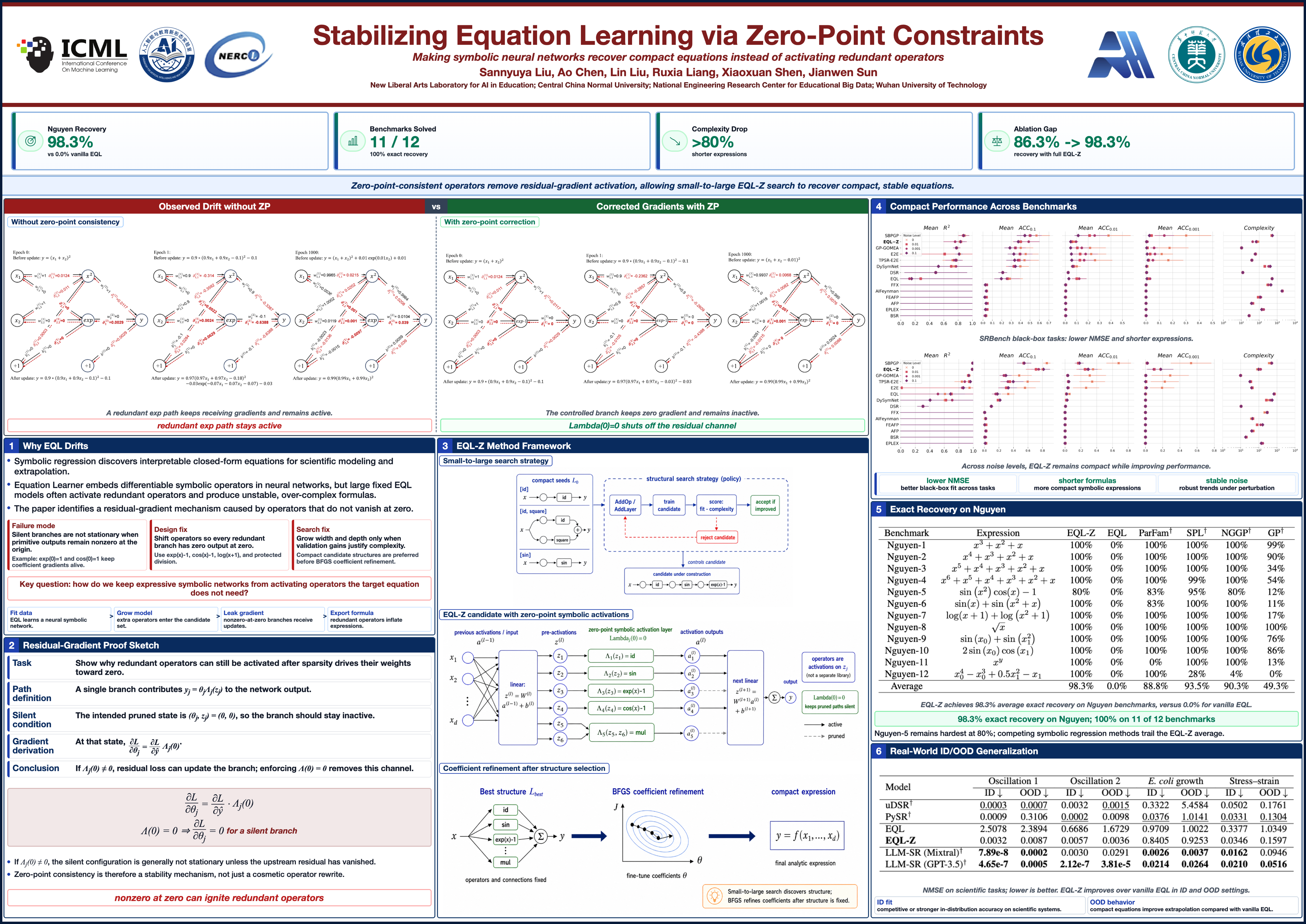
Symbolic Regression aims to discover interpretable mathematical expressions from data. Equation Learner (EQL) is a gradient-based method with strong fitting capability and expressive potential, yet it often activates redundant operators as model complexity grows, leading to over-complex expressions and unstable equation recovery. We analyze a gradient residual issue induced by operators that do not vanish at zero, which can prevent the ideal sparse expression from acting as a stable attractor during training and bias training toward unnecessarily complex structures, making exact recovery highly unreliable in practice. To address this, we propose EQL-Z, a structurally controllable symbolic regression framework. EQL-Z enforces zero-point constraints via zero-point consistent operator transformations to eliminate residual gradients on silent paths, and performs a small-to-large structure search that grows depth/width from a compact seed under a complexity-penalized validation score. After selecting a compact structure, we apply BFGS fine-tuning to refine coefficients. Experiments on synthetic and real-world datasets show that EQL-Z substantially improves exact equation recovery and in-/out-of-distribution generalization over vanilla EQL, achieving performance close to leading symbolic regression baselines. Code is available at https://github.com/Caaaa-a/EQL-Z.
Lay Summary
Scientists often want to discover simple equations that explain how the world works. For example, a dataset may come from a physical experiment, and the goal is not only to predict future measurements, but also to find a clear mathematical rule behind them. This task is called symbolic regression. A popular way to do this is to train a neural network whose building blocks are mathematical operations. However, these models can easily activate unnecessary operations during training, leading to equations that are too complicated or unstable. We introduce EQL-Z, a method that makes this process more reliable. It changes mathematical operations so that unused parts of the model naturally stay inactive, and it builds equations gradually from small structures rather than starting with an overly large model. Our experiments show that EQL-Z recovers correct equations much more reliably than the original Equation Learner, produces simpler expressions, and generalizes better to new data. This makes symbolic regression more useful for scientific discovery, where both accuracy and interpretability are important.