
Learning to Refine: Spectral-Decoupled Iterative Refinement Framework for Precipitation Nowcasting
Abstract
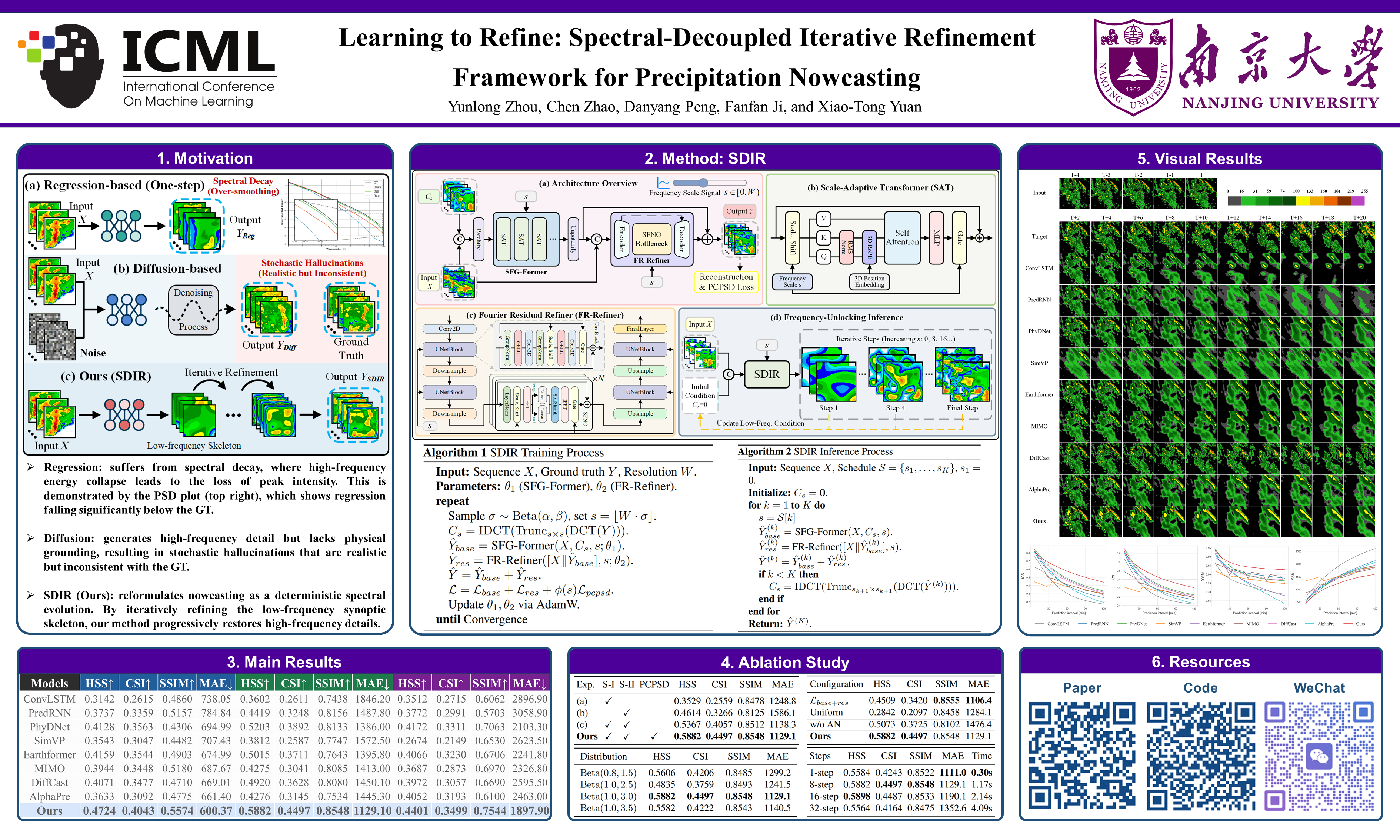
Accurate precipitation nowcasting is vital for disaster mitigation, but deep learning methods face a key trade-off: regression models produce over-smoothed, spectrally decaying predictions that blur convective details and violate turbulence power laws; diffusion models generate realistic yet unanchored hallucinations lacking physical grounding. We propose Spectral-Decoupled Iterative Refinement (SDIR), a deterministic framework that reformulates nowcasting as progressive frequency-decoupled refinement. SDIR first extracts a stable low-frequency synoptic skeleton, then iteratively refines high-frequency textures under physical constraints, eliminating both blurring and hallucinations. It features a dual-path design: the Synoptic Frequency-Guided Former (SFG-Former) with Scale-Adaptive Transformers for global structure, and the Fourier Residual Refiner (FR-Refiner) with Scale-Conditioned Fourier Neural Operators for fine residuals. A Physically Consistent Power Spectral Density (PCPSD) loss with dynamic masking enforces a turbulence-consistent spectral distribution. Experiments on three benchmarks show SDIR significantly outperforms SOTA methods in spatial accuracy while achieving spectral fidelity competitive with diffusion-based methods, enabling reliable high-resolution operational nowcasting. Code link: https://github.com/RuntimeWarning/SDIR.
Lay Summary
Predicting where and how hard it will rain in the next few hours is essential for flood warnings and disaster response, yet it remains surprisingly difficult for AI systems. Current approaches face a fundamental dilemma: some produce predictions that look blurry and miss small but intense storm cells, while others generate sharp-looking but physically unreliable forecasts that can "invent" rainfall where none actually exists. We introduce SDIR, an AI framework that resolves this dilemma by tackling the problem in two stages — first capturing the broad, large-scale structure of a storm system, then progressively filling in fine-grained details guided by physical laws governing how energy distributes in the atmosphere. Unlike prior methods, SDIR never sacrifices physical consistency for visual sharpness, or vice versa. Tested on three standard benchmarks, SDIR outperforms existing state-of-the-art models in both accuracy and physical realism, making it a trustworthy tool for real-world operational weather forecasting.