
From Generalist to Specialist Representation
Abstract
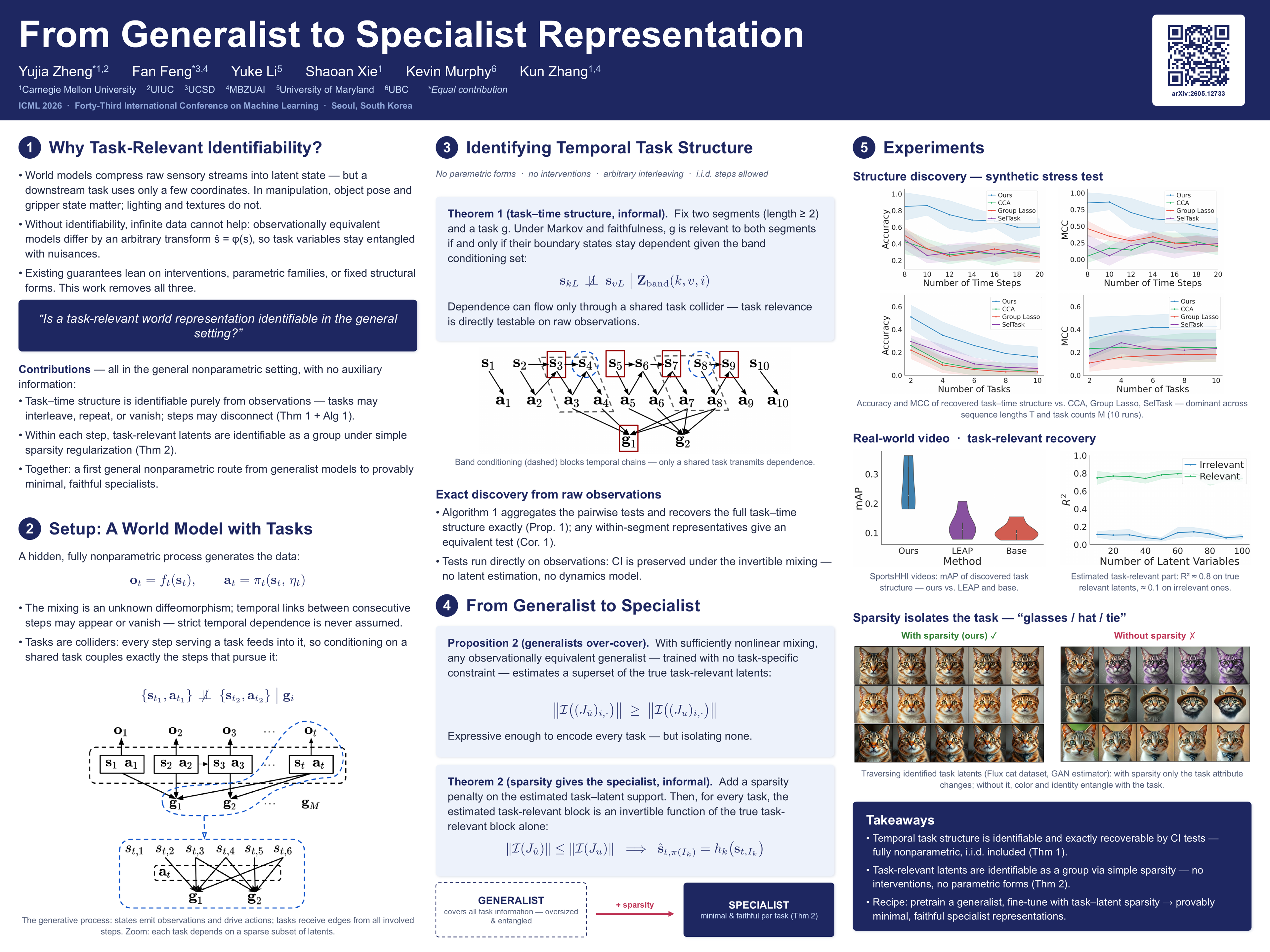
Given a generalist model, learning a task-relevant specialist representation is fundamental for downstream applications. Identifiability, the asymptotic guarantee of recovering the ground-truth representation, is critical because it sets the ultimate limit of any model, even with infinite data and computation. We study this problem in a completely nonparametric setting, without relying on interventions, parametric forms, or structural constraints. We first prove that the structure between time steps and tasks is identifiable in a fully unsupervised manner, even when sequences lack strict temporal dependence and may exhibit disconnections, and task assignments can follow arbitrarily complex and interleaving structures. We then prove that, within each time step, the task-relevant latent representation can be disentangled from the irrelevant part under a simple sparsity regularization, without any additional information or parametric constraints. Together, these results establish a hierarchical foundation: task structure is identifiable across time steps, and task-relevant latent representations are identifiable within each step. To our knowledge, each result provides a first general nonparametric identifiability guarantee, and together they mark a step toward provably moving from generalist to specialist models.
Lay Summary
Today’s AI systems are often trained to do many things at once. But for important applications, we want models that can focus on the information truly relevant to a specific task, instead of mixing together useful and irrelevant details. Our work studies whether this hidden task-relevant knowledge can actually be recovered from data in a reliable way. We prove that, under very general conditions, AI systems can automatically discover both the hidden structure of tasks over time and the internal representations most relevant to each task, even without human supervision or carefully designed assumptions. These results provide a theoretical foundation for building future AI systems that move from broad “generalist” behavior toward more specialized and reliable intelligence.