
Learning to Emulate Chaos: Adversarial Optimal Transport Regularization
Abstract
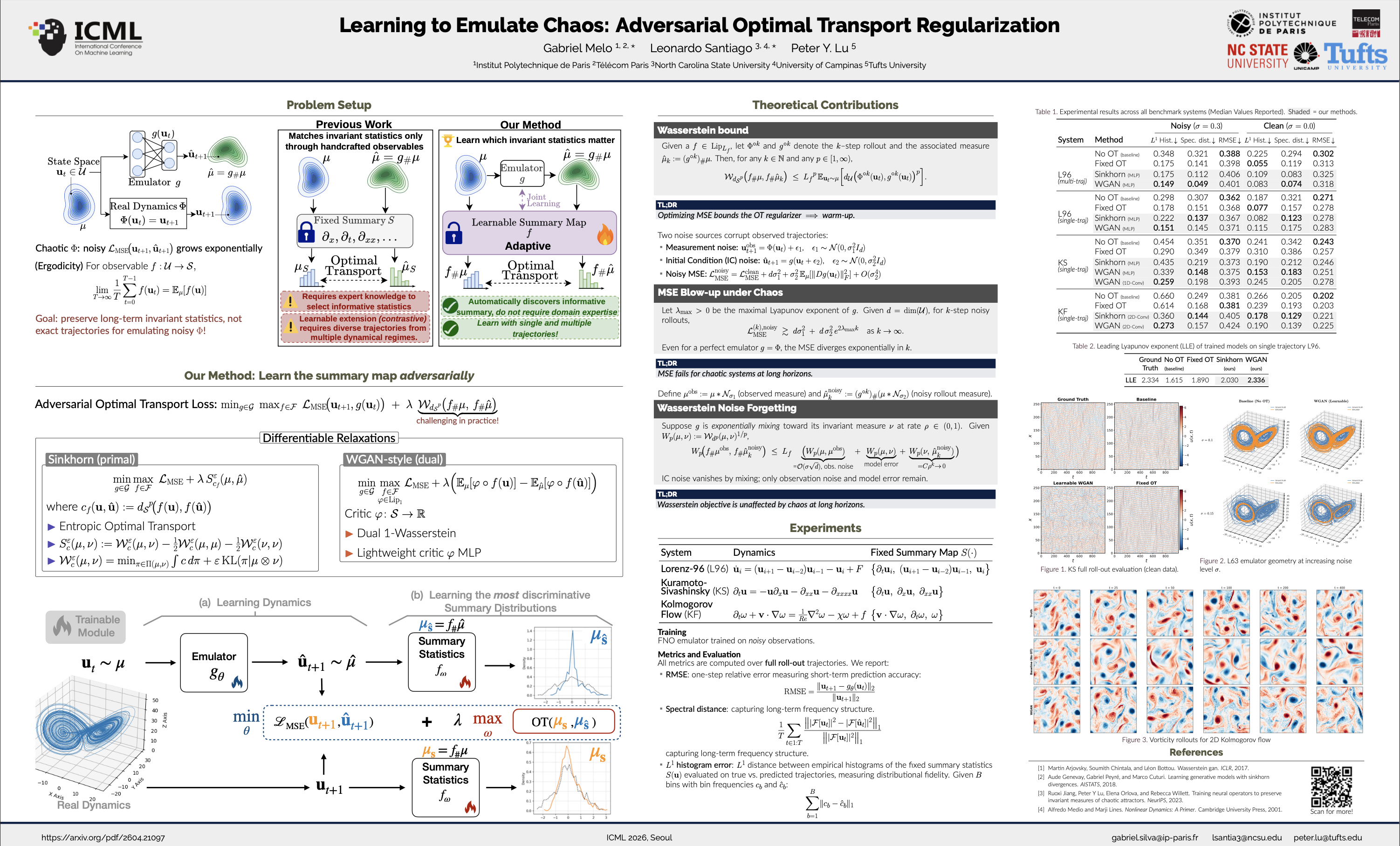
Chaos arises in many complex dynamical systems, from weather to power grids, but is difficult to accurately model with data-driven methods such as machine learning emulators. While emulators are promising tools for accelerating simulations and solving inverse problems, they still struggle to learn chaotic dynamics, where sensitivity to initial conditions renders exact long-term forecasts infeasible, especially given noisy data. Recent work instead trains emulators to match the statistical properties of chaotic attractors, but these approaches often rely on handcrafted summary statistics or large, diverse multi-environment datasets. In this work, we propose a family of adversarial optimal transport objectives that can jointly learn high-quality summary statistics and a physically consistent emulator from a single noisy trajectory. We theoretically analyze and experimentally validate a Sinkhorn divergence formulation (2-Wasserstein) and a WGAN-style dual formulation (1-Wasserstein) of our approach. Numerical experiments across a variety of chaotic systems, including ones with high-dimensional spatiotemporal chaos, show that emulators trained using our proposed objectives have significantly improved long-term statistical fidelity.
Lay Summary
Many systems that matter in science and engineering, such as weather, fluids, and power grids, are chaotic: tiny errors in their current state can quickly grow, making exact long-term prediction impossible. This creates a problem for machine learning models trained to predict the next state as accurately as possible, especially when the available measurements are noisy. Instead of trying to follow one exact future path, our work trains models to reproduce the long-term patterns of the system, such as the shapes and statistics that appear over time. We introduce a method that automatically learns which patterns are most important for distinguishing realistic chaotic behavior from unrealistic model behavior. The model is then trained to match these learned patterns while still remaining locally accurate. Importantly, our approach can learn from a single observed trajectory, rather than requiring many separate simulations or expert-designed measurements. Across several chaotic systems, our method produces models that better preserve the long-term behavior of the true system. This can help build more reliable machine learning tools for simulating complex physical systems where exact prediction is not possible.