
How to Avoid Debate: Scalable AI Safety via Doubly-Efficient Interactive Proofs
Abstract
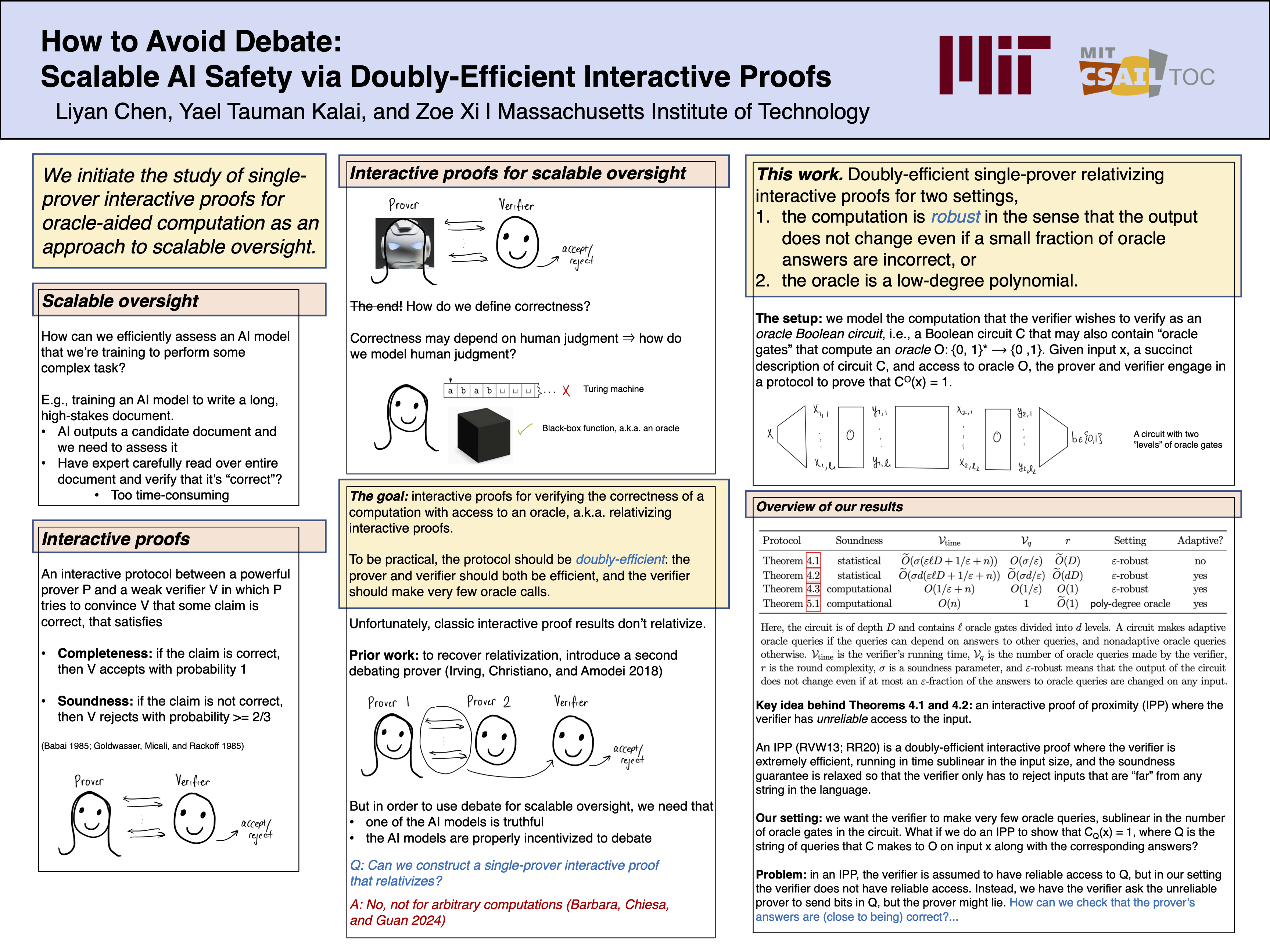
As AI models continue to develop powerful capabilities, it becomes critical that we are able to verify that their output is aligned with our intentions. A recent line of work focuses on verification via debate, a model of interactive proofs where two competing powerful provers, or AI models, debate each other to convince a weak verifier, or a human, of the correctness of their claim. However, debate assumes that the two AI models possess equal abilities and that one of them is truthful, which may not be realistic. In this work, we show how to avoid debate: we initiate the study of single-prover interactive proofs for AI safety. Prior results in single-prover interactive proofs do not immediately carry over to the AI safety setting because they do not work when the computation has access to an oracle, such as to human judgment or an external database such as the web. We present doubly-efficient single-prover interactive proofs for oracle-aided computations (also known as relativizing proofs), in the settings where (1) the computation is robust, in the sense that the output does not change if at most a small fraction of the answers to oracle queries are incorrect, or (2) the oracle is a low-degree polynomial. These results suggest that interactive verification is possible even without debate, under structured or noise-tolerant oracle access.
Lay Summary
As AI models become more capable, it is increasingly important to be able to verify that their outputs are trustworthy. One proposed approach to this problem is “AI debate,” in which two AI models debate each other in front of a human judge, with the hope that mistakes or dishonesty will be exposed during the debate. However, debate assumes that one of the AI models is honest and that both sides are evenly matched, which may not always be realistic. In this paper, we initiate the study of a different approach that avoids debate entirely. Instead of relying on two competing AI models, we show that a single AI model can interact with a human in a way that still allows the human to efficiently verify complicated computations. We focus on settings where the computation may rely on external sources of information, such as human feedback or databases, which creates challenges that previous theoretical results have not addressed. We prove that efficient verification is still possible in two natural settings: (1) where the computation tolerates small amounts of incorrect information or (2) where the external information has a strong mathematical structure. Our results suggest that verification of AI outputs is possible even without debate.