
Q-Tab: Quantized Tabular Data Generator
Abstract
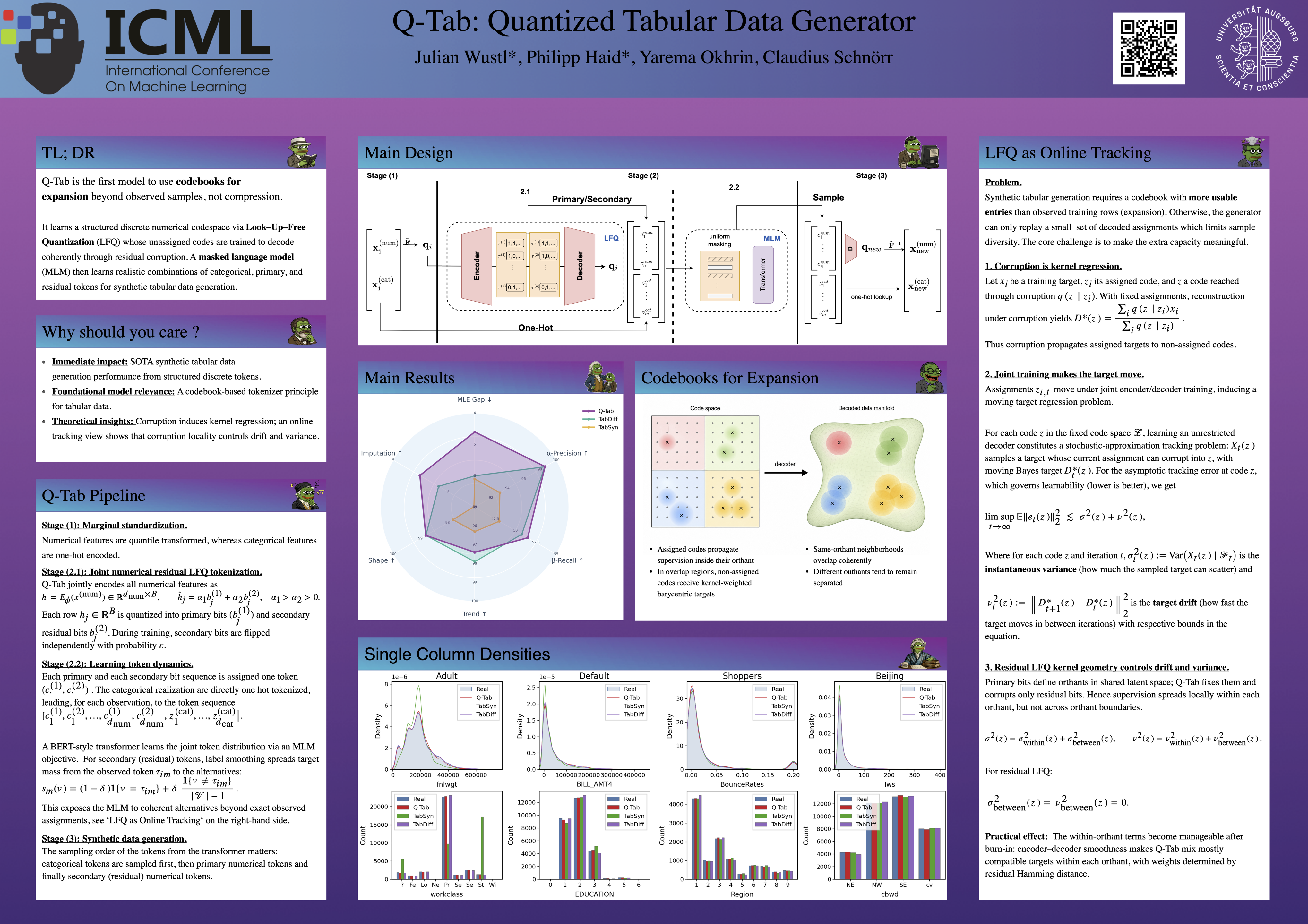
Codebook-based generators built on masked language model (MLM) transformers have become highly effective in text and vision, yet remain underused for tabular data. This is because codebooks typically act as information bottlenecks, whereas synthetic tabular generation requires a code space larger than the training sample, with additional codes trained to support new tabular rows. We address this gap with Q-Tab, a codebook-based tabular generator that uses lookup-free quantization (LFQ) with residual corruption to jointly tokenize numerical variables, categorical variables are directly one-hot tokenized. A BERT-style MLM captures dependencies in the token space and can then be sampled from. Corruption propagates reconstruction supervision across the numerical code space, but under joint encoder–decoder training induces a moving-target regression problem whose difficulty depends on the corruption structure. This motivates residual LFQ as the quantization mechanism, balancing broader supervision with locality. Q-Tab achieves state-of-the-art predictive utility and label prediction, while matching the distributional fidelity of diffusion-based generators.
Lay Summary
A lot of data is organized in tables, such as medical records, customer data, or survey results. Researchers often want to use such data to train machine learning models, test analysis pipelines, fill in missing values, or share data safely, but real tables can be difficult to access because of privacy concerns. This paper introduces Q-Tab, a method for generating realistic synthetic tabular data that can be used as a practical substitute for real data in downstream machine learning tasks. Q-Tab turns numerical information into discrete tokens, similar to how language models process words, and learns how these tokens interact across a table. This allows it to generate new rows that preserve important patterns needed for prediction and analysis, rather than merely looking realistic. Experiments show that Q-Tab improves performance on key downstream tasks such as predictive modeling and label prediction, while also maintaining competitive data quality and privacy behavior.