
Optimizing Inference-Time Compute for Medical Reasoning via Uncertainty Quantification
Abstract
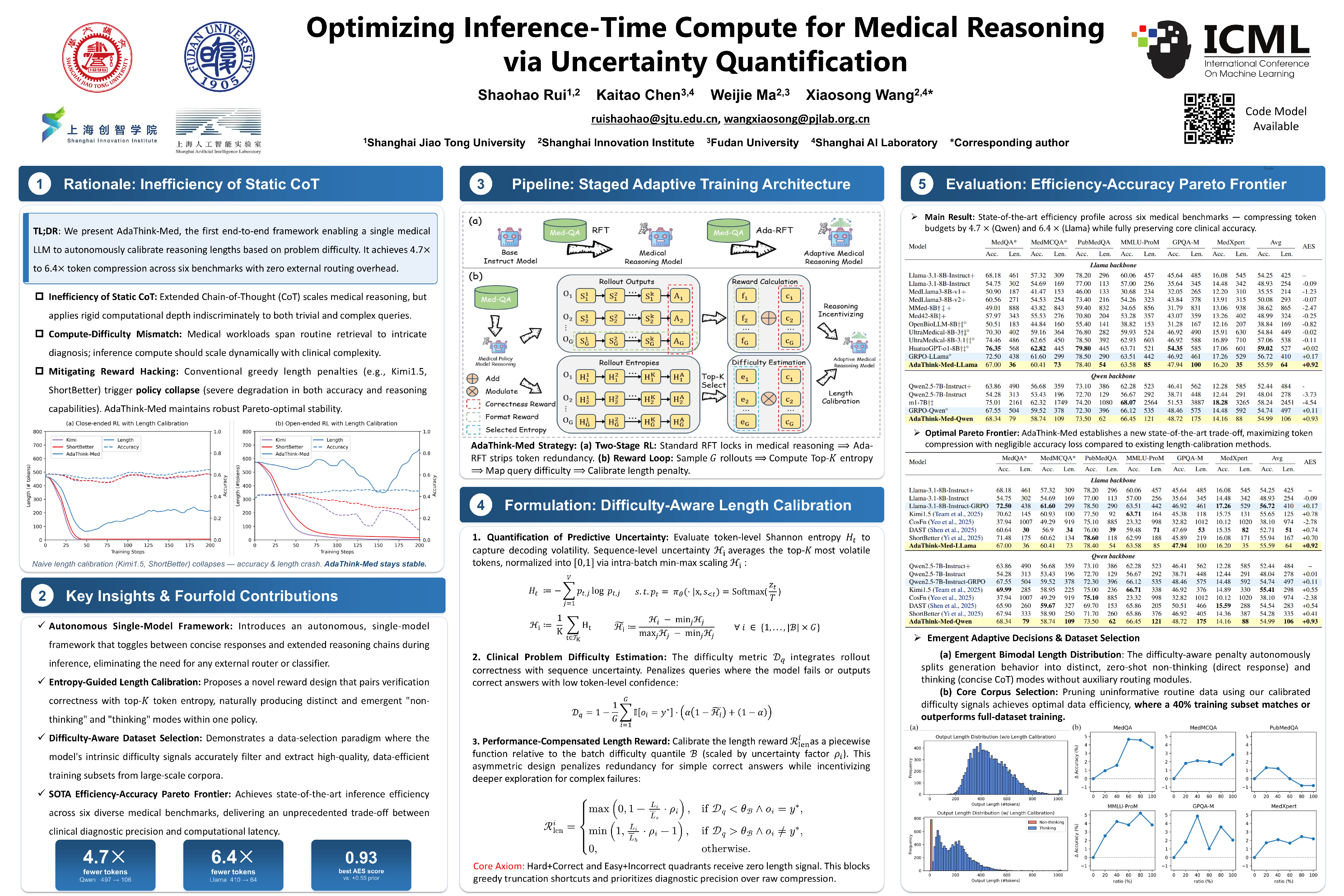
Extended Chain-of-Thought (CoT) reasoning has significantly bolstered the capabilities of medical large language models (LLMs). However, current models exhibit static computational expenditure, applying lengthy reasoning processes indiscriminately to both simple queries and complex diagnostic cases. This inefficiency is particularly prohibitive in real-world healthcare, where clinical scenarios range from time-sensitive emergencies requiring rapid response to intricate pathologies demanding deep analysis. To address this, we propose AdaThink-Med, an end-to-end framework for adaptive reasoning via uncertainty-guided length calibration. Although the underlying mechanism is generalizable, we demonstrate its critical value in the medical domain, where balancing inference latency with diagnostic precision is paramount. AdaThink-Med leverages entropy-based uncertainty estimation within reinforcement fine-tuning to dynamically shape reward signals: it penalizes verbosity for high-confidence correct answers (e.g., straightforward knowledge retrieval) while incentivizing extended exploration for uncertain or ambiguous scenarios. Across six medical benchmarks, AdaThink-Med reduces inference token consumption by 4.7× to 6.4× on Qwen and Llama architectures, respectively, with minimal performance trade-offs. Notably, our reward design naturally produces distinct "non-thinking" and "thinking" modes within a single model, enabling efficient allocation of computational resources without any external router or classifier.
Lay Summary
Modern medical AI assistants tackle complex clinical questions by generating long step-by-step reasoning before answering—much like a student showing their work on a math test. The problem is that they do this for every question, no matter how trivial, wasting time, energy, and computing cost. In an emergency room, where every second can affect patient outcomes, this kind of unnecessary delay is more than just inefficient—it can be harmful. We built AdaThink-Med, a training method that teaches a single medical AI model to automatically decide how much to "think" based on the difficulty of each question. The key idea is to let the model gauge its own confidence: when it is sure of an answer, it responds briefly; when it is uncertain or facing a complex case, it reasons more deeply. Crucially, this all happens inside one model—no extra classifier or routing system is required. Across six medical question-answering benchmarks, AdaThink-Med produces correct answers using up to six times less text than current systems, with essentially no loss in accuracy. In a real-world validation on 796 anonymized cardiac stroke cases, board-certified physicians rated its diagnoses and treatment plans as more accurate and less wordy than competing methods. The result is faster, cheaper, and more sustainable medical AI that could one day help clinicians make better decisions under tight time pressure.