
Q-CLIP: Unleashing the Power of Vision-Language Models for Video Quality Assessment through Unified Cross-Modal Adaptation
Abstract
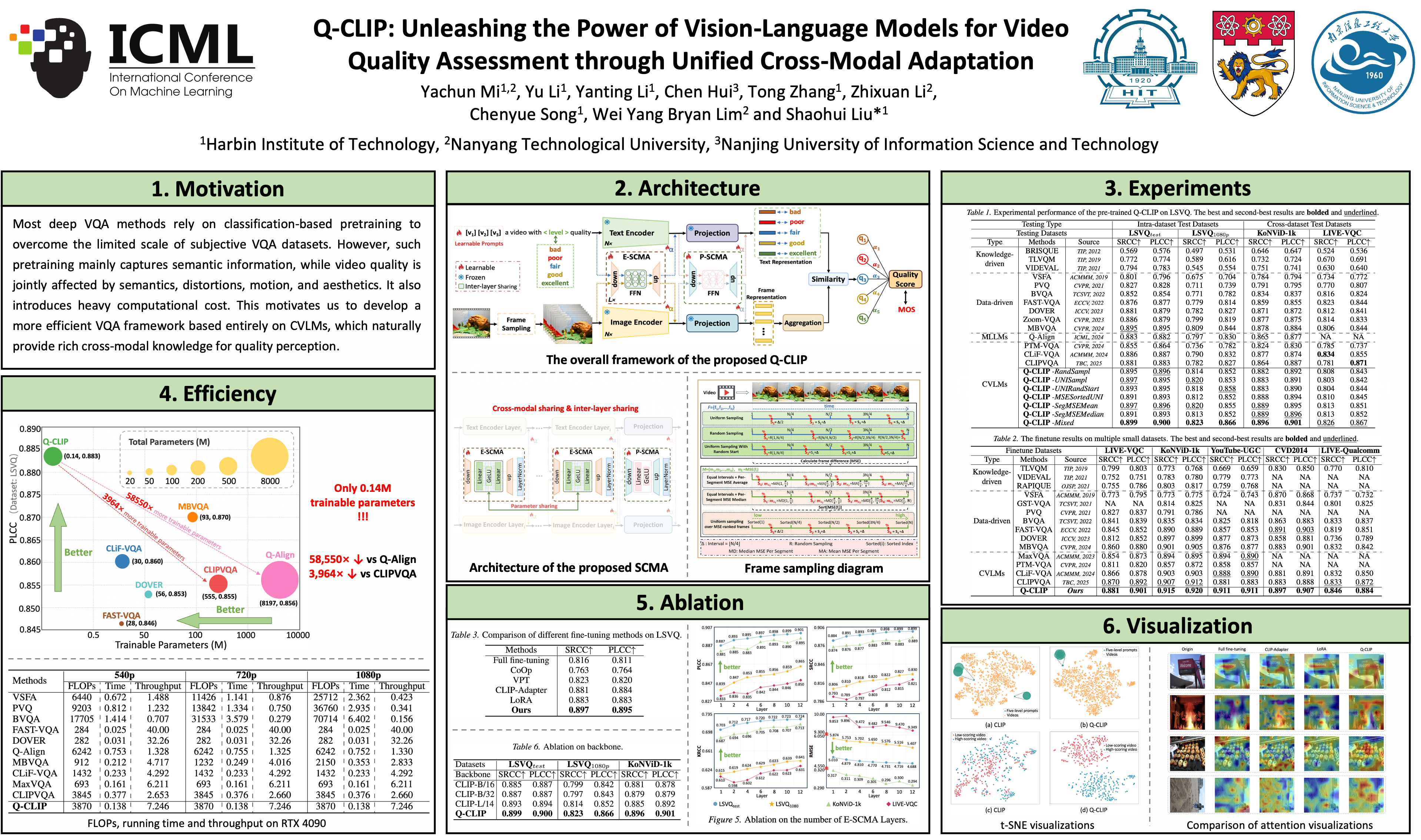
Accurate and efficient Video Quality Assessment (VQA) has long been a key research challenge. Current mainstream VQA methods typically improve performance by pretraining on large-scale classification datasets, followed by fine-tuning on VQA datasets. However, this strategy presents two significant challenges: (1) merely transferring semantic knowledge learned from pretraining is insufficient for VQA, as video quality depends on multiple factors (e.g., semantics, distortion, motion); (2) pretraining on large-scale datasets demands enormous computational resources, often dozens to hundreds of times more than training on VQA datasets. Recently, Contrastive Vision-Language Models (CVLMs) have shown strong generalization across visual tasks and promising potential for quality assessment. In this work, we propose Q-CLIP, the first fully CVLMs-based framework for VQA. Q-CLIP enhances both visual and textual representations through a Shared Cross-Modal Adapter (SCMA), which contains only a minimal number of trainable parameters and is the only component that requires training. This design significantly reduces computational cost. In addition, we introduce a set of five learnable quality-level prompts to guide the CVLMs in perceiving subtle quality variations. Furthermore, we investigate the impact of different frame sampling strategies on VQA performance. Extensive experiments demonstrate that Q-CLIP exhibits excellent performance on several VQA datasets. Code: https://github.com/xiao-mi-d/Q-CLIP
Lay Summary
Online videos often differ in visual quality, and low quality videos can reduce user experience. Predicting video quality is hard because it depends on content, motion, and visual defects such as blur and noise. We present a method that adapts a vision and language model to estimate video quality. The model keeps most of the original model fixed and trains only a small adapter, which makes training efficient. It also uses five quality levels, to guide the model in judging small quality differences. We further study how different ways of selecting video frames affect quality prediction. Experiments on several public datasets show that the proposed method gives accurate results with much lower training cost than many existing methods.