
Reliable Confidence Alignment for Generalized Category Discovery
Abstract
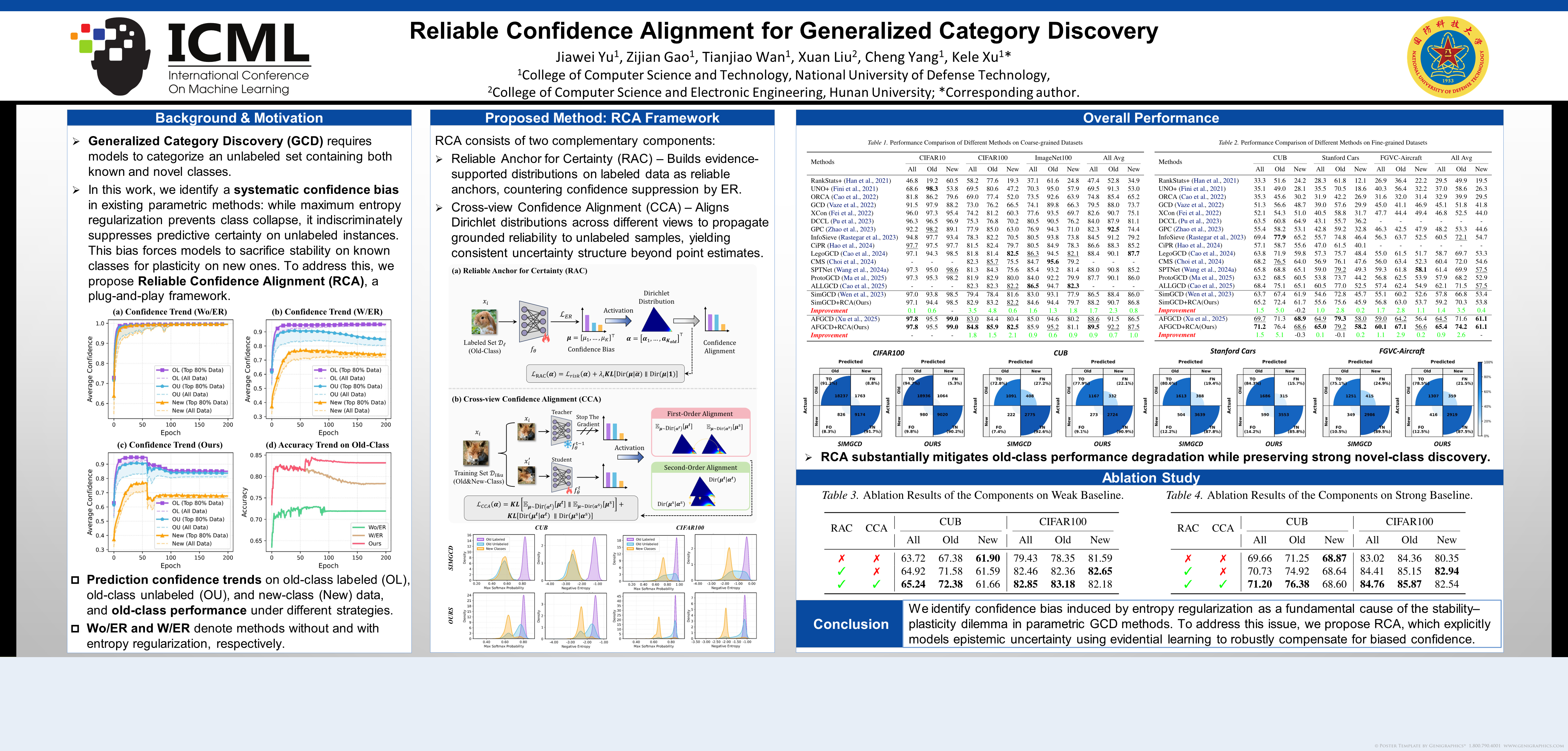
Generalized Category Discovery (GCD) requires models to categorize an unlabeled pool containing known and novel classes under sparse supervision. We identify a systemic confidence bias inherent in existing parametric methods: while entropy regularization prevents class collapse, it indiscriminately suppresses predictive certainty on all unlabeled instances. This bias drives a distributional wedge between labeled and unlabeled samples of the same category, forcing models to sacrifice their stability on known classes to achieve plasticity for new ones. To resolve this, we propose Reliable Confidence Alignment (RCA), a plug-and-play framework grounded in Evidential Deep Learning. RCA first establishes high certainty anchors on labeled data using a Reliable Anchor for Certainty (RAC) module. Then, we introduce Cross-view Confidence Alignment (CCA) to propagate this grounded reliability to the unlabeled discovery set. Thus, RCA captures the fine-grained geometry of the probability simplex, effectively calibrating the model's epistemic uncertainty. Extensive evaluations on coarse- and fine-grained benchmarks demonstrate that RCA effectively rectifies the confidence landscape, significantly mitigating performance decay on known classes without compromising novel-class discovery.
Lay Summary
Traditional AI models often struggle in the real world—such as in autonomous driving or medical diagnostics—where unexpected new categories constantly appear. To address this, researchers use a paradigm called "Generalized Category Discovery," which requires the AI to classify a mixed pool of data containing both known and entirely new categories. However, to prevent the model from over-focusing on known categories, current methods usually introduce a constraint mechanism to force the exploration of new ones. This unfortunately causes the AI to lose confidence in the classes it has already learned well, thereby degrading its original accuracy. To fix this confidence imbalance, we developed a framework called Reliable Confidence Alignment (RCA). Acting as a smart confidence calibrator, RCA first uses the known data to establish firm "certainty anchors" and then propagates this reliable confidence structure to the unlabelled mixed data. This mitigates a classic dilemma in artificial intelligence: how to embrace new concepts without undermining the mastery of previous knowledge. Ultimately, our approach significantly improves the AI's stability on familiar tasks while fully preserving its sharp ability to discover entirely new categories.