
Agentic Numeric Optimization for Nutrition Planning
Abstract
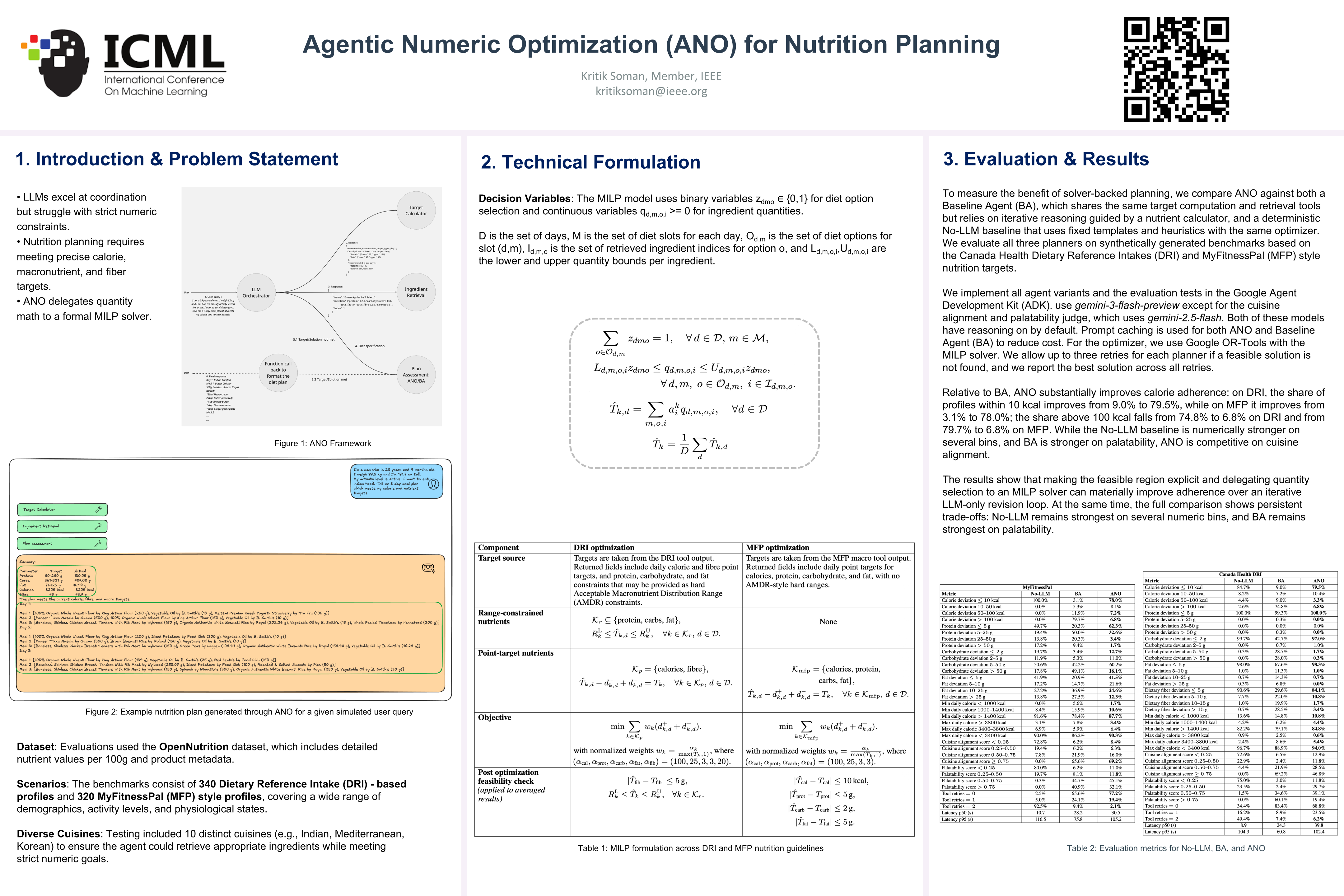
We introduce Agentic Numeric Optimization (ANO), a framework for nutrition planning that combines a Large Language Model (LLM) orchestrator with a numeric optimizer for meal selection and quantity assignment. Given a free-text user profile query, ANO computes dietary targets, retrieves matching ingredients from the OpenNutrition dataset, builds a structured diet specification, and calls the optimizer to assign ingredient quantities. To measure the benefit of solver-backed planning, we compare ANO against both a Baseline Agent (BA), which shares the same target-computation and retrieval tools but relies on iterative reasoning guided by a nutrient calculator, and a deterministic No-LLM baseline that uses fixed templates and heuristics with the same optimizer. We evaluate all three planners on synthetically generated benchmarks based on the Canada Health Dietary Reference Intakes (DRI) and MyFitnessPal (MFP) style nutrition targets. Relative to BA, ANO substantially improves calorie adherence: on DRI, the share of profiles within 10 kcal improves from 9.0\% to 79.5\%, while on MFP it improves from 3.1\% to 78.0\%; the share above ~100 kcal falls from 74.8\% to 6.8\% on DRI and from 79.7\% to 6.8\% on MFP. While the No-LLM baseline is numerically stronger on several bins, and BA is stronger on palatability, ANO is competitive on cuisine alignment.