
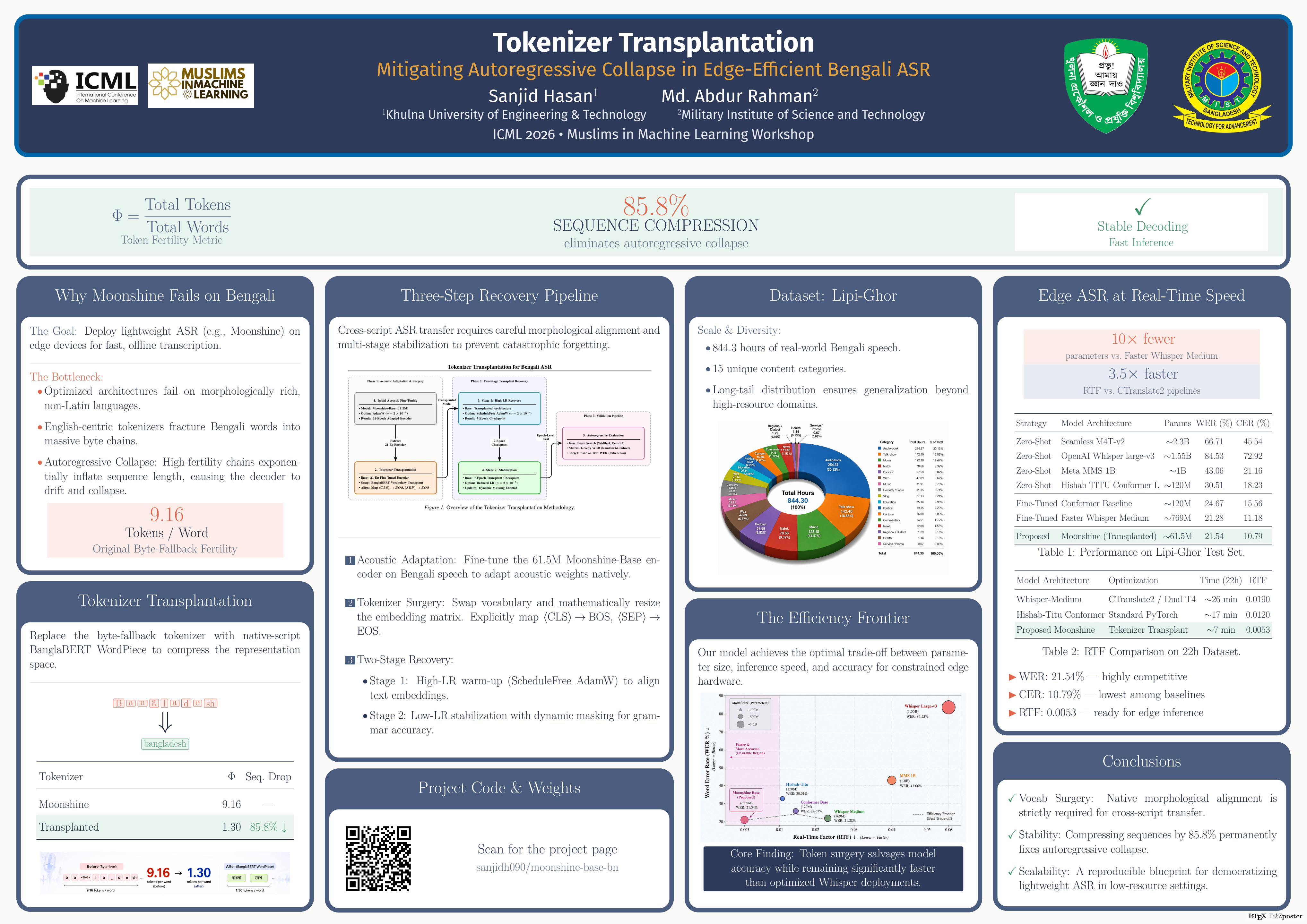
Tokenizer Transplantation: Mitigating Autoregressive Collapse in Edge-Efficient Bengali ASR
Abstract
Lightweight speech recognition models are critical for edge deployment, yet highly optimized architectures like Moonshine often fail on morphologically rich, non-Latin languages such as Bengali. This study identifies the root cause of this failure as the model's English-centric byte-level tokenizer, which fragments Bengali words into high-fertility byte chains and triggers catastrophic autoregressive collapse during inference. To resolve this, a novel vocabulary transplantation pipeline is proposed to surgically replace the decoder's embedding matrix with a native-script BanglaBERT WordPiece vocabulary. Experimental results demonstrate a reduction in token fertility from 9.16 to 1.30. By decreasing autoregressive sequence length by 85.8\%, decoding instability is entirely mitigated. When evaluated on the 882-hour Lipi-Ghor dataset, the modified architecture achieves a state-of-the-art 20.4\% Word Error Rate (WER) and a Real-Time Factor (RTF) of 0.0053. Ultimately, this research provides a scalable, reproducible blueprint for cross-script adaptation of compact ASR models without the need for resource-intensive pre-training.