
Crowd Navigation for Mobile Robots with Focused Risk Perception
Abstract
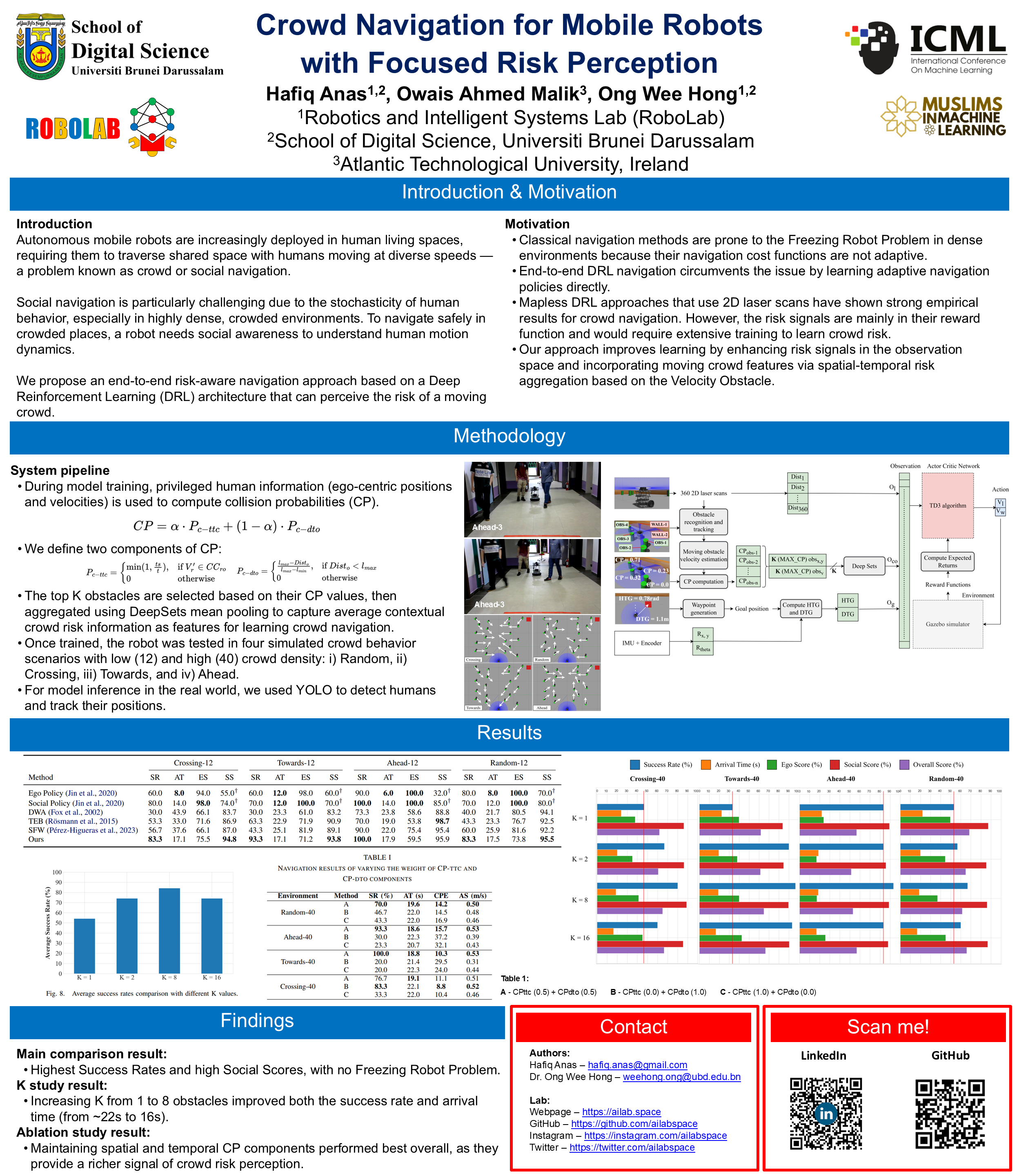
Current state-of-the-art crowd navigation approaches are mainly deep reinforcement learning (DRL)-based but often struggle to generalize to unseen crowd behaviors and to scale efficiently with crowd density. We propose a DRL method that incorporates risk perception directly into the observation space: collision probability is used to identify the K most hazardous obstacles, whose relative positions and velocities are exposed to the policy, and local waypoints are added to the reward to densify the learning signal. Trained once in the Gazebo simulator with a non-cooperative randomized crowd, our model is evaluated on four crowd-behavior scenarios against a 2D-laser DRL baseline, a human-aware social planner, and two classical planners. Our approach achieves significantly higher success rates and social safety across all settings, generalizes to unseen crowd behaviors without fine-tuning, and is further validated in real-world tests.