
Evaluating the Predictive Added Value of Dynamics-Aware Spatial Partitions Under Tactical Distribution Shift
Abstract
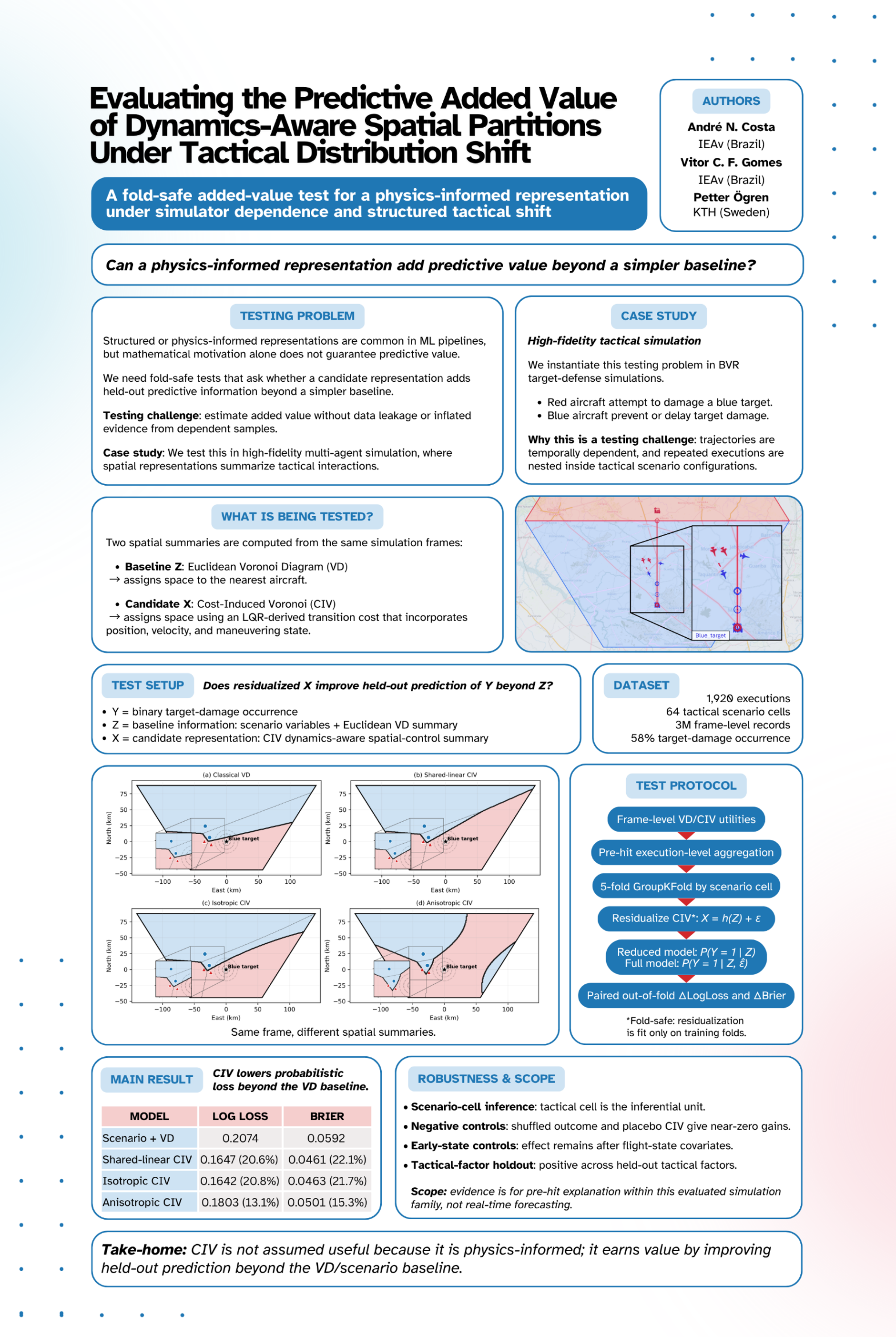
Classical Voronoi Diagrams (VD) provide interpretable spatial partitions for multi-agent systems, but Euclidean proximity is often an incomplete proxy for influence in aerospace engagements, where velocity, mass, and control effort affect spatial dominance. We evaluate whether Linear Quadratic Regulator (LQR)-derived Cost-Induced Voronoi (CIV) summaries provide target-relevant information beyond classical VD geometry and tactical scenario descriptors in high-fidelity air combat simulations. Formulating this as a fold-safe conditional added-value test, CIV features are residualized against the VD and scenario baseline within each training fold, and their explanatory contribution is evaluated using paired out-of-fold probabilistic losses over execution-level pre-hit summaries. The resulting added-value signal persists under scenario-cell clustered inference, negative controls, early flight-state controls, and leave-one-factor-out validation. Within the evaluated scenario family, CIV provides consistent pre-hit explanatory added value for binary target-damage occurrence, supporting its utility as a dynamics-aware representation of the active engagement phase.