
From Risk Scoring to Risk Allocation: A Density-Driven Framework for Diverse Monitoring in Multi-Agent Systems
Abstract
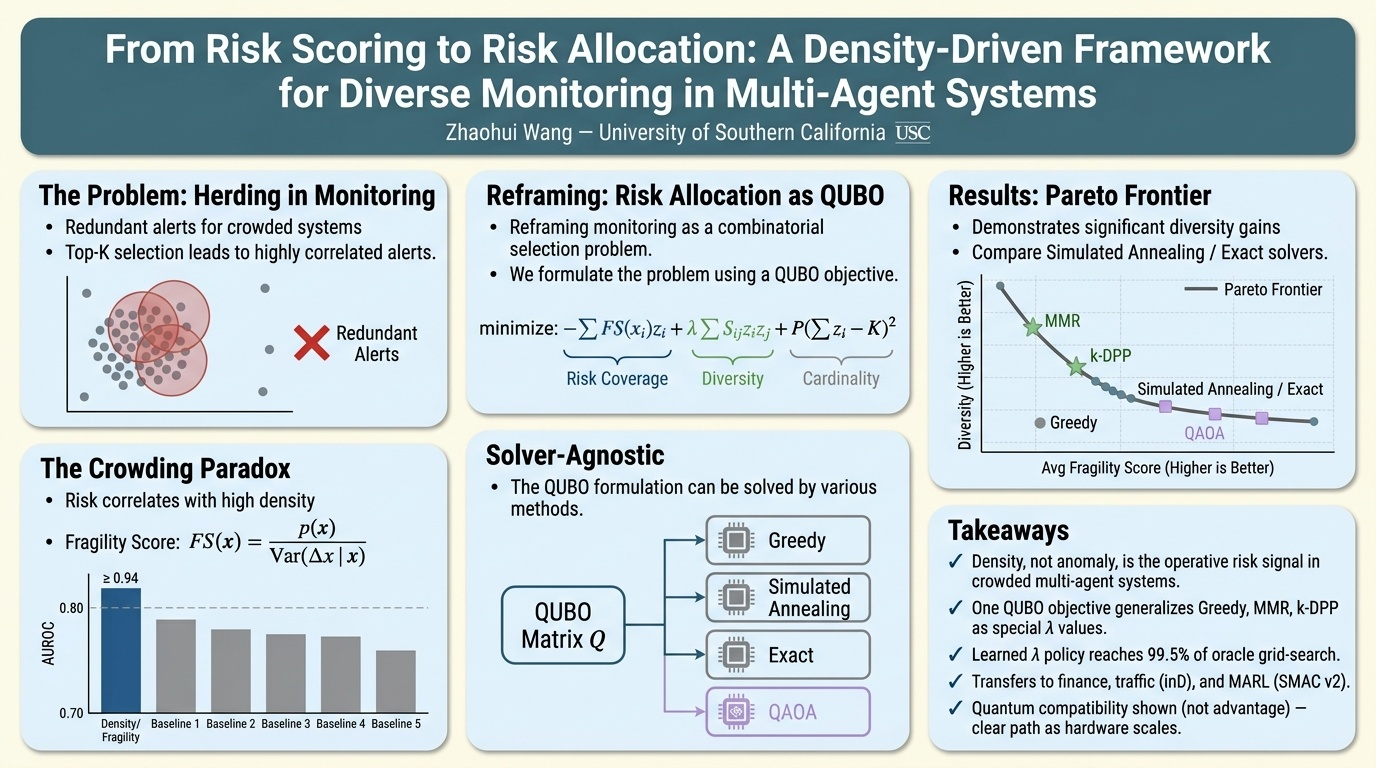
Risk monitoring in multi-agent systems is commonly built on a per-state primitive that scores each state independently and selects the top K. Under crowding, where many agents share the same fragility, this approach picks redundant alerts whose risks are jointly correlated, a pattern we describe as “herding in monitoring.” We propose a paradigm shift from risk scoring to risk allocation, supported by two contributions. First, we identify the Crowding Paradox, namely that P(risk | x) is proportional to p(x) rather than 1/p(x), so density rather than anomaly score is the operative risk signal; on financial data, density-based scoring reaches AUROC ≥ 0.94 at 5d/10d/20d crash horizons, while five anomaly baselines all fall below 0.80. Second, given a density-derived fragility score, we recast monitoring as combinatorial subset selection over interdependent states and map it to a QUBO objective with a lambda-controlled risk–diversity tradeoff. The resulting Pareto frontier contains standard diverse-subset methods (MMR, k-DPP) as fixed operating points; the gain over greedy grows monotonically with scale, from +24% at n = 15 to +66% at n = 200; a learned lambda policy reaches 99.5% of an oracle grid-search objective; and the formulation transfers to traffic and multi-agent reinforcement learning. The same QUBO instances execute without modification on Rigetti superconducting QPUs (Ankaa-3 and Cepheus-1-108Q via Amazon Braket), which we report as a compatibility property of the formulation rather than a claim of quantum advantage at this scale.