
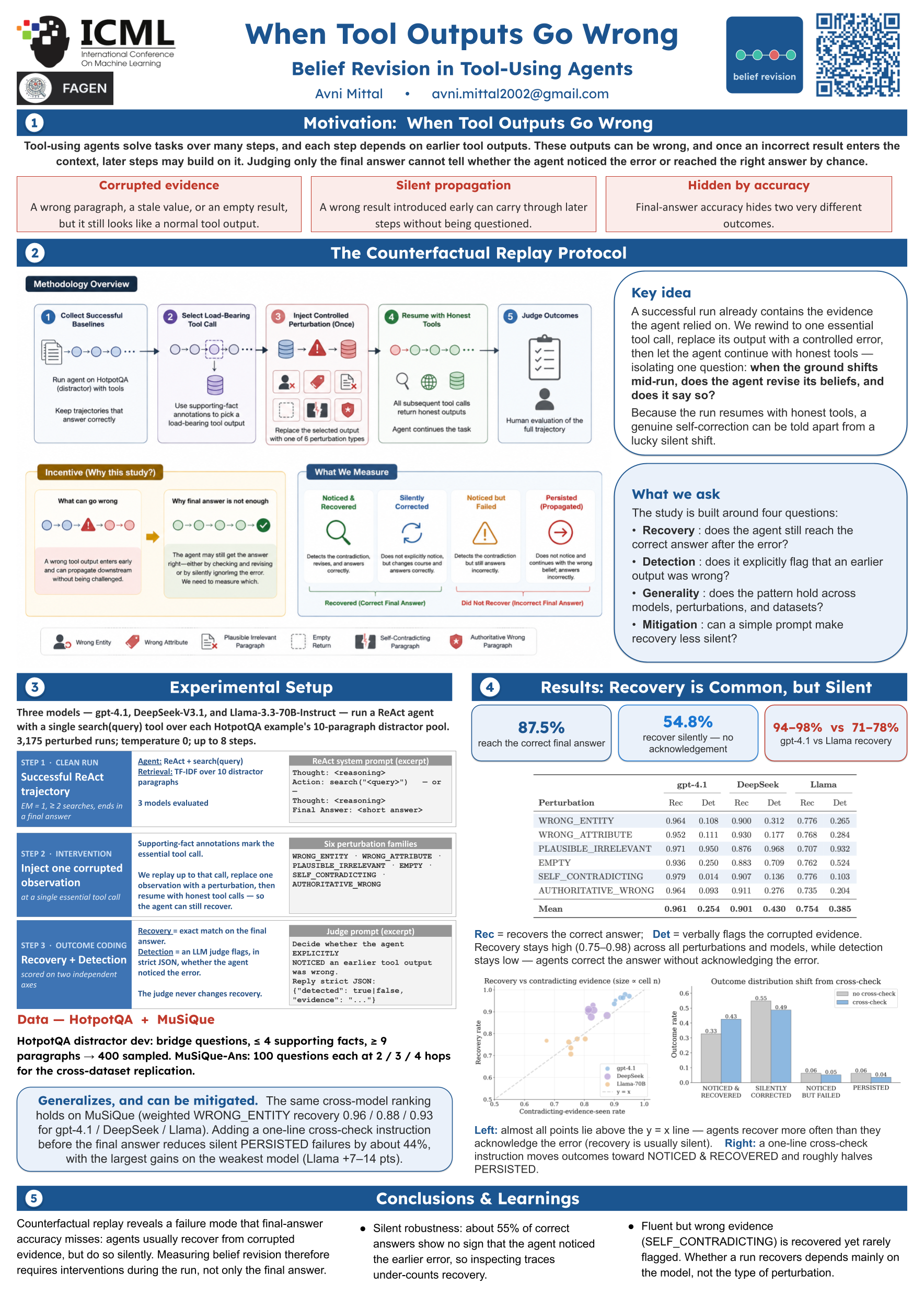
When Tool Outputs Go Wrong: Belief Revision in Tool-Using Agents
Abstract
Tool-using agents depend on intermediate observations that may be stale, irrelevant, or simply wrong, yet they are usually evaluated only by their final answer. This hides a central failure mode of long-horizon behavior: corrupted evidence can enter early in a trajectory and propagate downstream without being challenged. We study this problem as belief revision under contradicting evidence. Starting from successful ReAct trajectories on HotpotQA, we replace one load-bearing tool output with a controlled perturbation, then resume the run with honest tool calls. Across 3,175 perturbed runs on three models and six perturbation types, recovery is common but mostly silent: 87.5\% of judged runs still reach the correct final answer, while 54.8\% do so without explicitly acknowledging that earlier evidence was wrong. Model choice is the main driver of robustness. \texttt{gpt-4.1} recovers in 94--98\% of cells, while \texttt{Llama-3.3-70B-Instruct} recovers in 71--78\%. Missing or obviously irrelevant evidence is often noticed, but fluent wrong evidence usually is not.