
Retrieval-Induced Forgetting in LLMs: A Reproducible Failure Mode and a Verified Fix
Shuzhen Li ⋅ Mengdi Wang
Abstract
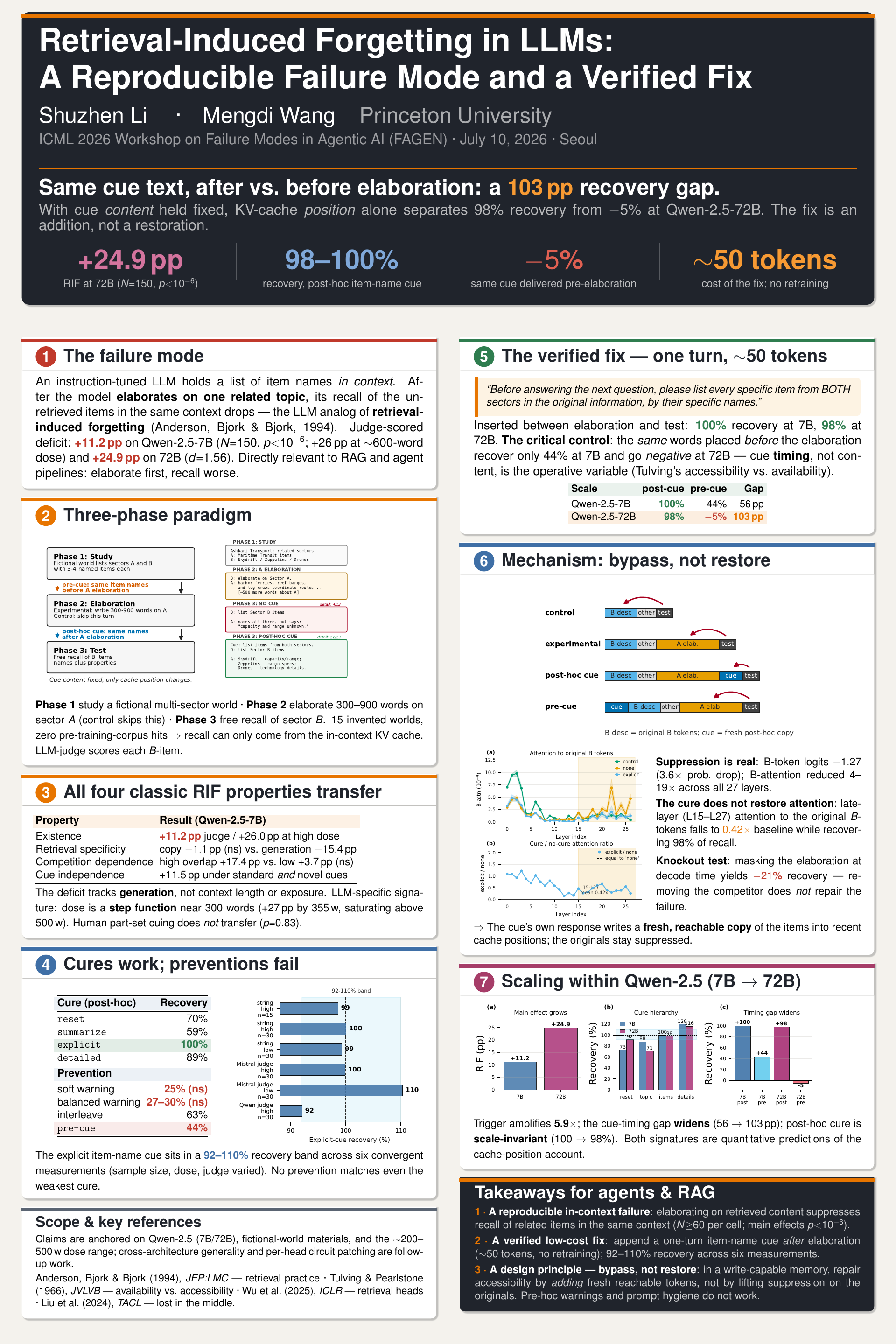
We document a content-controlled cue-timing dissociation in instruction-tuned LLMs: the same item-name list, delivered post-hoc versus pre-elaboration, opens a 103 pp recovery gap at Qwen-2.5-72B (98% vs. −5%). Cue content is held fixed across the contrast; only its position in the KV cache differs. The underlying failure is elaboration-induced suppression of in-context recall: when the model elaborates on one of several related items present in its context, its later recall of the others drops by +11.2 pp on Qwen-2.5-7B (judge-scored, N=150, $p<10^{-6}$ ) and by +24.9 pp on its 72B sibling. A one-turn post-hoc "list every item by name" prompt reverses the deficit (100% recovery at 7B, 98% at 72B); the same text delivered before the elaboration recovers only half as much at 7B and becomes harmful at 72B. Per-layer attention extraction shows that the cure lowers late-layer attention to the original target tokens to 0.42× baseline rather than restoring it, and an attention-mask intervention on the elaboration positions yields −21% recovery. Together these favor a bypass-not-restore reading: the cure writes a fresh reachable copy of the items into recent KV-cache positions while the originals stay suppressed.
Chat is not available.
Successful Page Load