
Constituting What Counts: A Phenomenological Approach to Human-AI Ontological Translation
Abstract
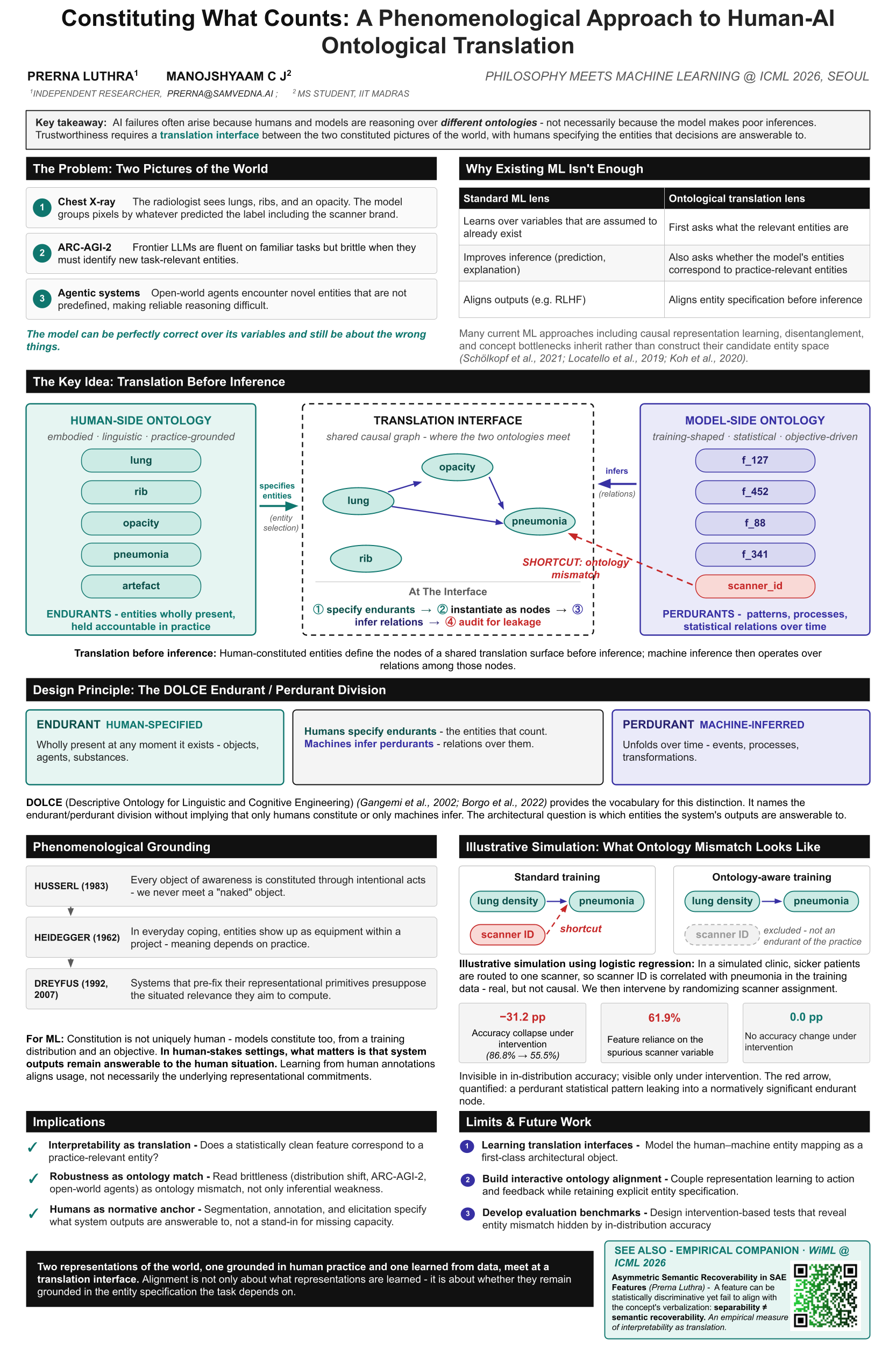
Modern AI systems - large language models and agentic systems increasingly stake claims about what entities exist in a scene and how they relate. We argue that humans and AI systems each build their own constituted picture of the world from their respective situated positions, and that these pictures do not automatically align. The trustworthiness question for modern AI is therefore not whether the model can learn the right ontology, but how to build a meeting point where the model's constituted picture and the human's can interact, so that what the model reasons about remains answerable to what the human cares about. Drawing on Husserl, Heidegger, and Dreyfus, and formalising via the DOLCE endurant/perdurant distinction, we propose an asymmetric translation interface - humans constitute endurants, machines infer perdurants over them - and ground the asymmetry normatively in accountability and situatedness rather than metaphysically in machine incapacity. We connect the argument to causal representation learning and LLM brittleness on novel-ontology tasks as the construction of a translation surface.