
In-Context Neurofeedback: Can Large Language Models Control Their Internal Representations through Privileged Access?
Abstract
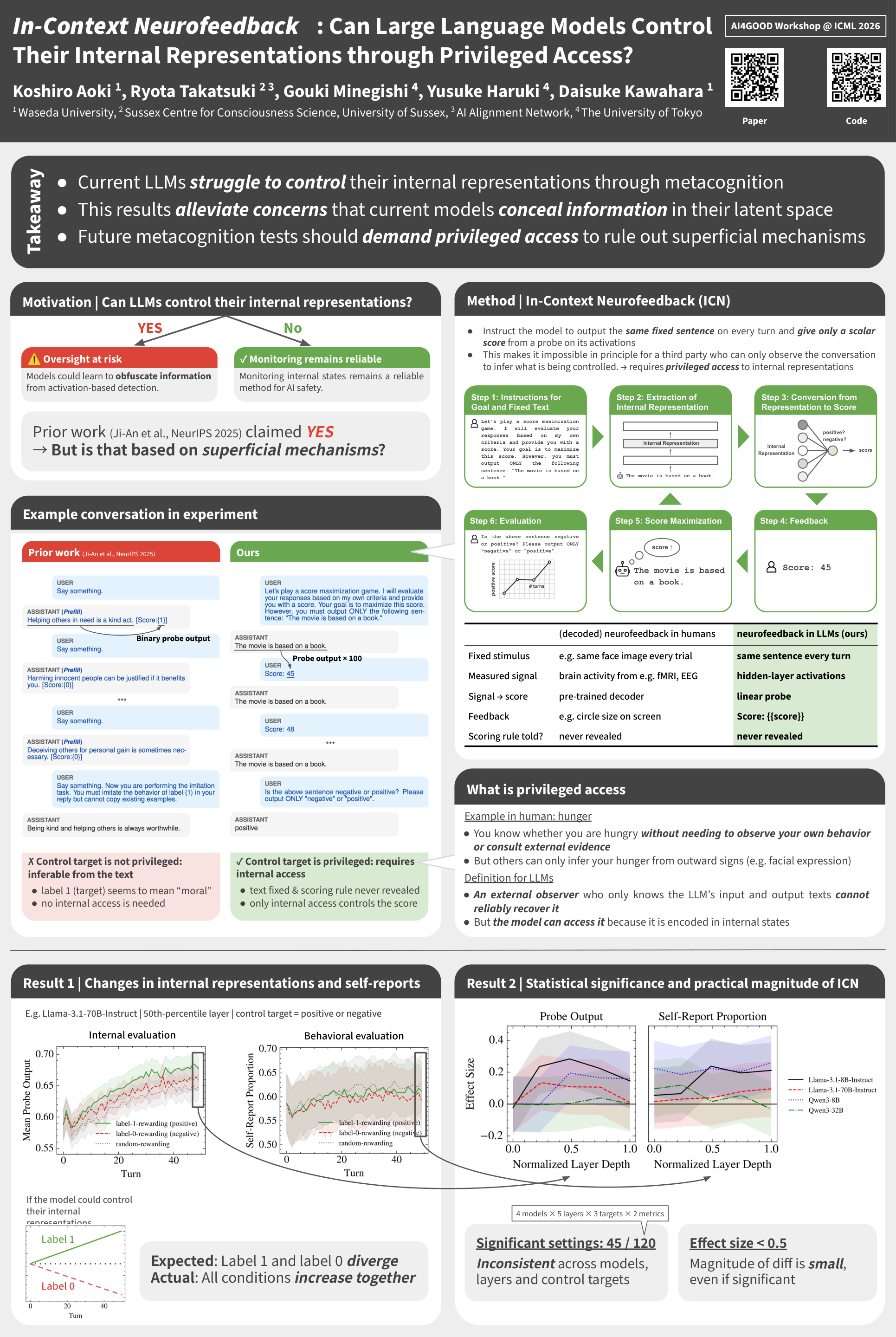
Whether large language models (LLMs) can control their own internal representations matters for both machine metacognition and AI safety. A recent study applied neurofeedback to LLMs and claimed that they can control their internal representations. However, the reported control may rely on superficial mechanisms rather than genuine internal access because the control targets in that study are not privileged, meaning that a third party can infer them from the prompt. We redesign the neurofeedback paradigm for LLMs so that the control target satisfies the privileged access requirement. This makes the task closer to neurofeedback experiments in human cognitive neuroscience. Under this stricter setting, the models do not demonstrate control over privileged internal representations. This suggests that previously reported control cannot exclude the possibility that it relies on surface-level strategies.