
DropKV: Decoupling Residual-Output Perturbation for Near-Optimal KV-Cache Eviction
Aozhong Zhang ⋅ Selcuk Gurses ⋅ Yanxia Deng ⋅ Naigang Wang ⋅ Chi-Chun Liu ⋅ Davis Wertheimer ⋅ Derrick Liu ⋅ Xin Li ⋅ Zi Yang ⋅ Felix X.-F. Ye ⋅ Penghang Yin
Abstract
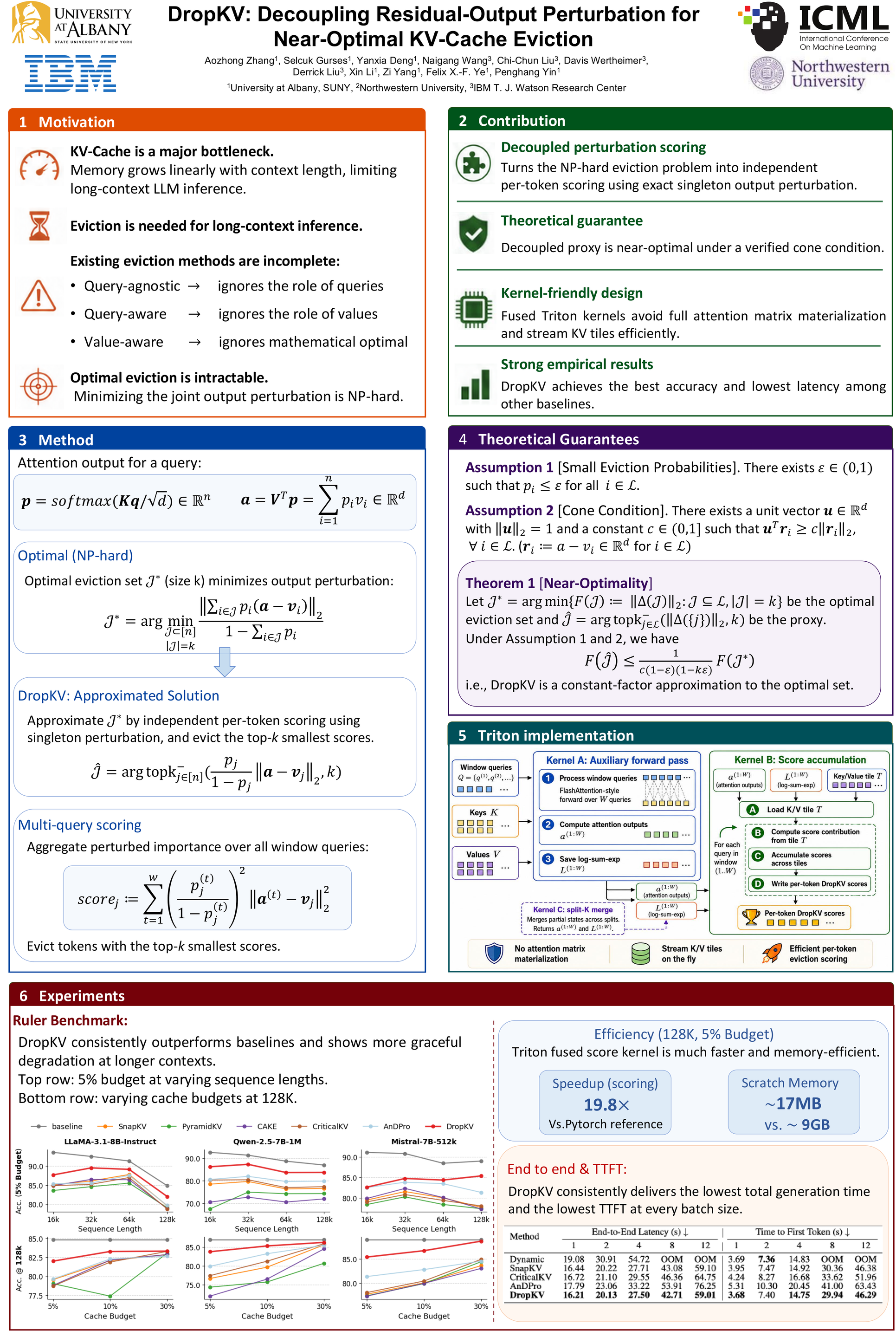
Key-value (KV) cache management has become a critical bottleneck for scaling Large Language Models (LLMs) to long-context scenarios due to linear memory growth. While recent eviction methods have moved beyond simple attention-score heuristics to incorporate value representations, they typically face a fundamental trade-off: the underlying optimization for minimizing output perturbation is an NP-hard combinatorial problem, leading to mathematically suboptimal heuristics or implementations that are difficult to kernelize. In this work, we propose DropKV, a simple principled eviction framework based on Decoupled Residual-Output Perturbation. By decoupling the joint eviction decision into independent per-token scoring, DropKV circumvents combinatorial intractability and admits a provable constant-factor approximation guarantee under a cone condition that we empirically verify on three long-context LLMs. To ensure practical viability, we provide a high-performance implementation using fused Triton kernels that avoid materializing the full attention matrix, delivering a 19.8$\times$ scoring-kernel speedup that translates to up to a 9.9\% matched-batch end-to-end prefill speedup. Extensive evaluations on the RULER and LongBench benchmarks demonstrate that DropKV consistently outperforms state-of-the-art baselines at equivalent cache budgets, achieving the lowest inference latency among eviction methods while also remaining faster than the dynamic cache baseline.
Chat is not available.
Successful Page Load