
When Agents Disagree With Themselves: Behavioral Consistency as an Uncertainty Signal for LLM Agents
Aman Mehta
Abstract
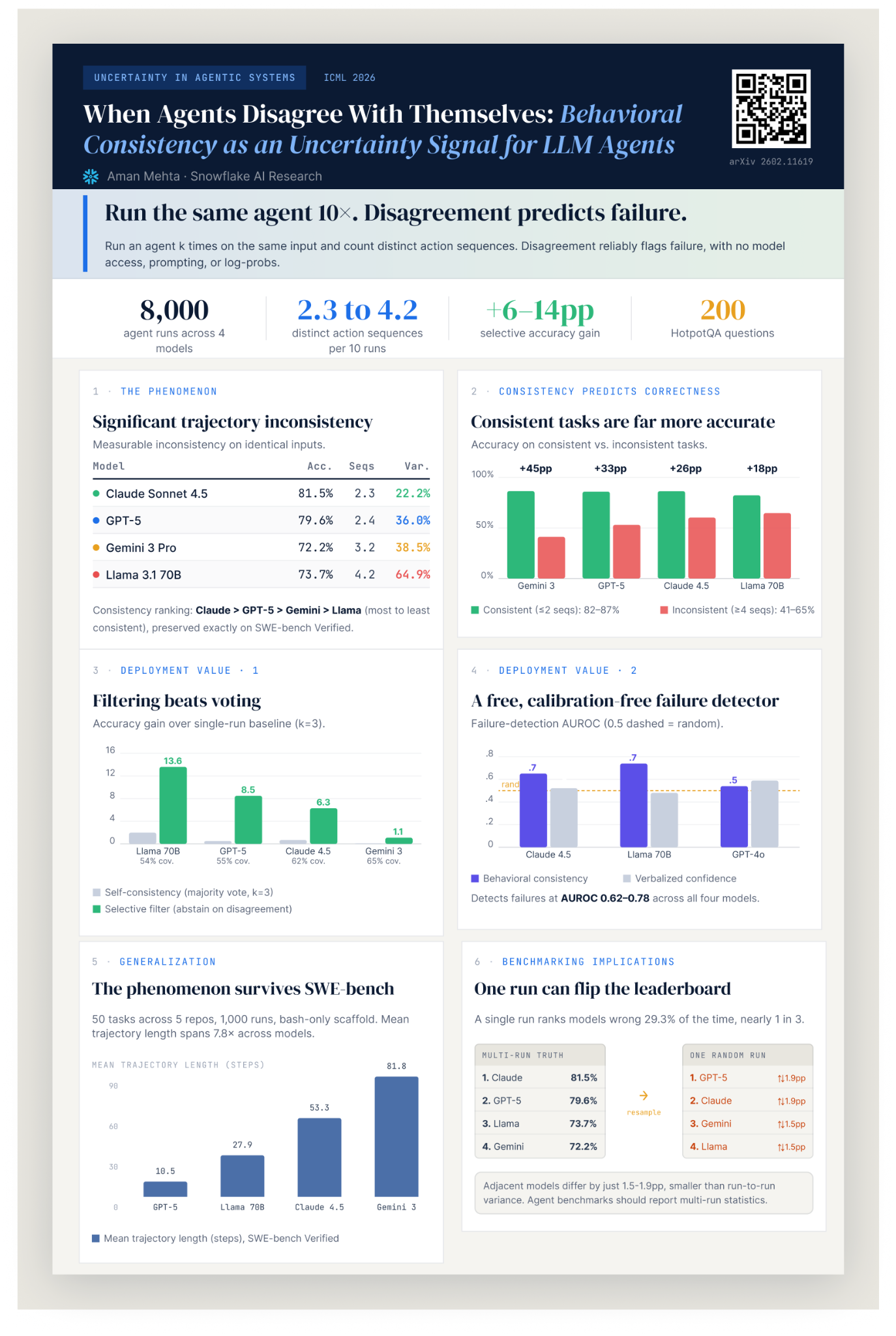
Running the same LLM agent on identical inputs yields 2.3-4.2 distinct action sequences per 10 runs; this behavioral variance constitutes a training-free, black-box uncertainty signal that instantiates selective classification and distribution-free calibration for agentic systems. Across 8,000 runs of four models on 200 HotpotQA questions, consistent tasks ($\leq 2$ unique paths) achieve 82-87% accuracy while inconsistent tasks ($\geq 4$ paths) achieve 41-65%, a gap that survives controls for task difficulty. Divergence concentrates at step 2 (50.5% of Llama tasks), and consistency metrics detect failures with AUROC 0.62-0.78. Exploiting this signal, selective prediction---answering only when $k = 3$ runs agree---achieves 87-88% accuracy at 54-62% coverage, a 6-14pp gain over single-run baselines, and matches a split-conformal baseline without a held-out calibration set. A cross-benchmark validation on SWE-bench (50 tasks, 1,000 runs) preserves the consistency hierarchy while revealing an $\sim 8\times$ spread in mean trajectory length across models, and bootstrap analysis shows single-run evaluations misrank models 29.3% of the time.
Chat is not available.
Successful Page Load