
FlowPDE: Understanding and Justifying Flow Matching in PDE Solving
Abstract
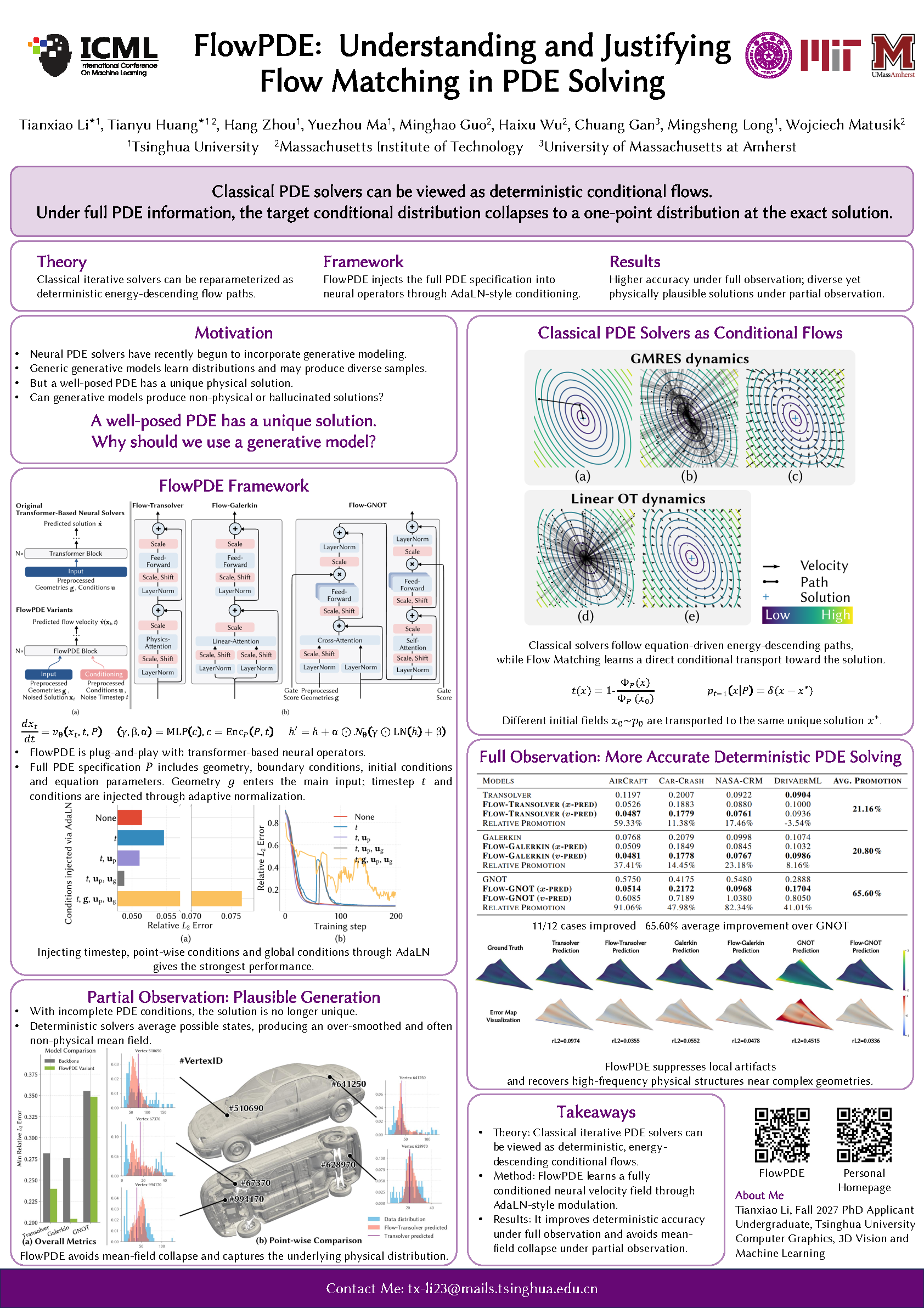
Neural PDE solvers have recently begun to incorporate generative modeling. However, applying generative models to PDE solving raises a fundamental question: the uniqueness of the solution of a well-posed PDE seems to conflict with the distributional nature of generative learning, and raises concerns about whether such models may introduce non-physical or hallucinated solutions. In this work, we provide a theoretical justification for using Flow Matching in neural PDE solving. We show that, under full problem information, the target conditional distribution collapses to a one-point distribution at the exact solution, and that classical iterative solvers can be viewed as deterministic energy-descending flow trajectories. Based on this insight, we propose FlowPDE, a general framework that equips existing transformer-based neural operators with a conditional flow matching model through AdaLN-style injection of PDE conditions. We provide a unified formulation for both fully observed and partially observed PDE problems. Experiments on diverse PDE benchmarks with complex geometries demonstrate that FlowPDE consistently improves over strong deterministic baselines across both full and partial observation regimes.