
Loss Landscape Diagnostics for Gradient-Based Inversion of the Gray-Scott System: Geometric Implications for PINN Design
Abstract
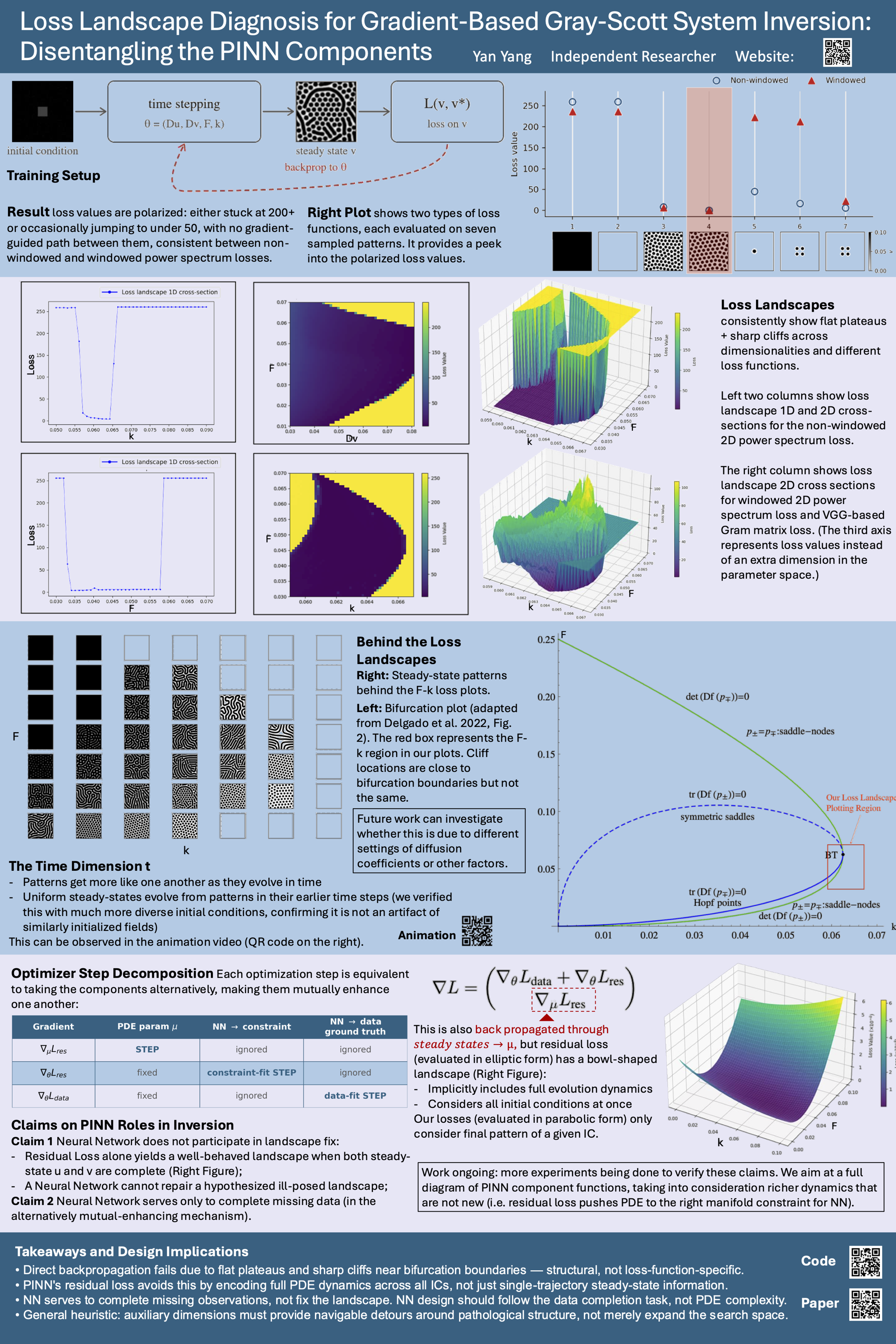
Using direct backpropagation as a diagnostic probe, we investigate gradient-based parameter inversion for the Gray-Scott reaction-diffusion system from steady-state patterns alone—without architectural augmentations or access to full temporal evolution. Empirical analysis reveals severe loss landscape pathologies: extensive flat plateaus with negligible gradient signal and sharp cliffs that block reliable optimization across multiple loss functions, motivating three directions toward viable gradient-based inversion. Theoretical analysis further shows that standard PINN-based approaches do not resolve these issues—the harsh landscape structure of the PDE parameter subspace persists regardless of the added neural network dimensions. Our principled analysis of the joint parameter space geometry identifies what properties additional dimensions must satisfy to enable effective optimization, with direct implications for PINN design. Together, these contributions form a foundation for future method design, specifically toward enabling tractable optimization for this class of inverse problems.