
Geometry, Not Energy Surface, Drives the Neutral MLIP–DFT Gap in Atomistic Interaction Surrogates
Rui Ding ⋅ Zixin Ding ⋅ Rodrigo P Ferreira ⋅ Yuxin Chen ⋅ Junhong Chen
Abstract
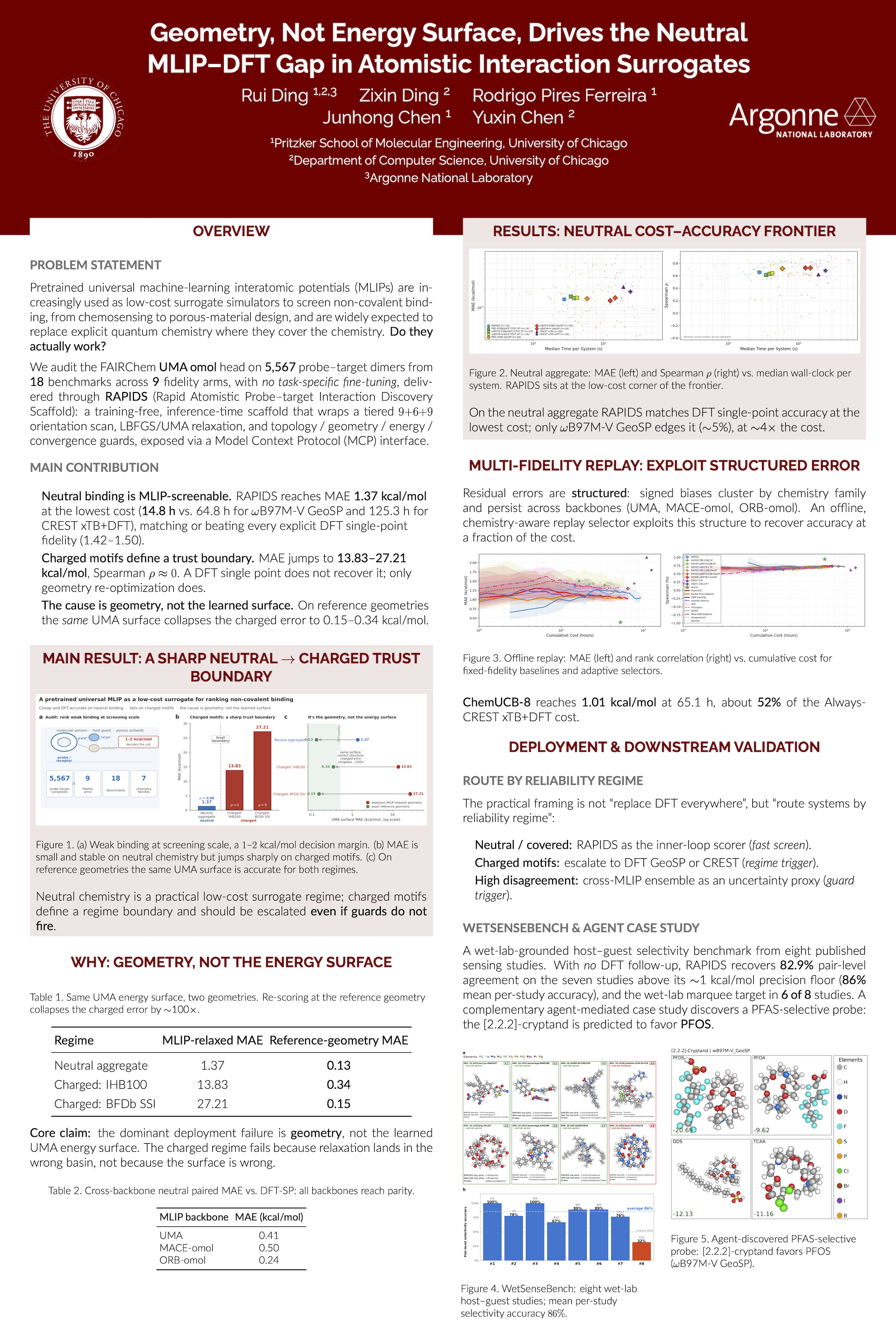
Pretrained universal machine-learning interatomic potentials (MLIPs) are now positioned as high-fidelity surrogate simulators for electronic-structure physics, widely expected to replace explicit quantum chemistry where they cover the chemistry. We show that on non-covalent binding, this expectation is mostly right, but mostly for the wrong reason. We audit the FAIRChem UMA omol head on 5,565 probe-target dimers from 18 benchmarks across nine fidelity arms, without any task-specific fine-tuning. Three findings emerge. First, the neutral MLIP-DFT gap is geometric rather than a learned-surface error: an explicit $\omega$B97M-V single point at the MLIP geometry leaves mean absolute error (MAE) at 1.64 kcal/mol, while reoptimizing the geometry drops it to 1.44, and MACE-omol and ORB-omol reach the same DFT-SP parity on neutral chemistry. Second, charged systems behave as a qualitatively different regime: MAE jumps to 13.83-27.21 kcal/mol with Spearman $\rho\approx 0$, a DFT single point does not recover it, only DFT geometry reoptimization does; and the failure persists across all three backbones. Third, the residual errors are structured: signed biases cluster by chemistry family, so a 10\% per-benchmark calibration offset improves neutral MAE to 1.32 kcal/mol at zero additional cost, and a chemistry-aware replay selector ChemUCB-8 reaches 1.06 kcal/mol at 52\% of the CREST xTB+DFT baseline cost. The audit is delivered through RAPIDS, a training-free inference-time scaffold exposed via a Model Context Protocol (MCP) interface and illustrated on a per- and polyfluoroalkyl substance (PFAS) sensing case study.
Chat is not available.
Successful Page Load