
Template Matching, Not Time Learning: A Diagnostic for Self-Supervised Light Curve Encoders
Emma Chickles
Abstract
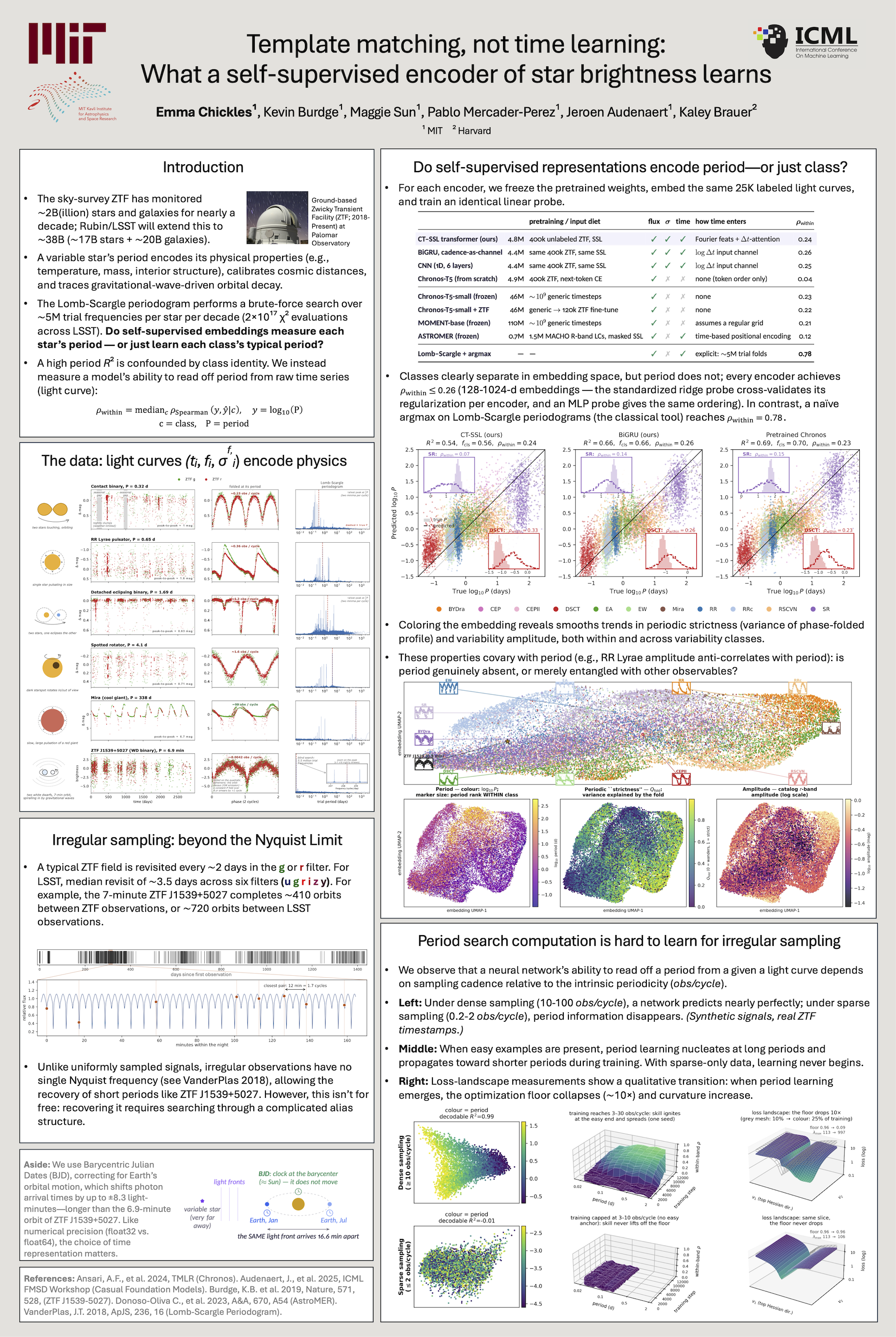
We propose period regression on catalogued variables as a diagnostic for whether a self-supervised encoder has learned absolute time on irregular astronomical photometry, or has merely template-matched class identity. Decomposing predicted-log-period variance into between-class and within-class components separates "the encoder identifies the class and predicts the class-mean period'' from "the encoder reads the period off this individual source's time series.'' Applied to eight encoders --- including pretrained Chronos-T5 ($46$M, $\sim 10^9$ cross-domain timesteps), pretrained MOMENT ($110$M), a $4.4$M cadence-as-channel BiGRU pretrained on $4{\times}10^5$ ZTF sources, and a $4.8$M continuous-time SSL transformer --- the diagnostic returns the same answer: \textbf{60--70\% of period-regression $R^2$ is between-class, and within-class Spearman $\rho$ stays at $0.20$--$0.26$ across every method tested.} An overall $R^2 = 0.685$ on $\log_{10}(P)$ that looks like time learning is, on decomposition, $\sim 70\%$ class-template matching with weak source-level refinement. None of the methods we tested have learned absolute time. As a control, retraining Chronos-T5 from scratch at matched scale collapses classification balanced accuracy from $0.650$ to $0.317$ and period $R^2$ from $0.685$ to $0.186$, isolating cross-domain pretraining as the dominant driver of pretrained-Chronos's downstream win --- but \emph{not} of any genuine time-encoding capability on this domain.
Chat is not available.
Successful Page Load