
Adapt the Data, Not the Model: Input-Space Adaptation for Frozen Time-Series Predictors
Abstract
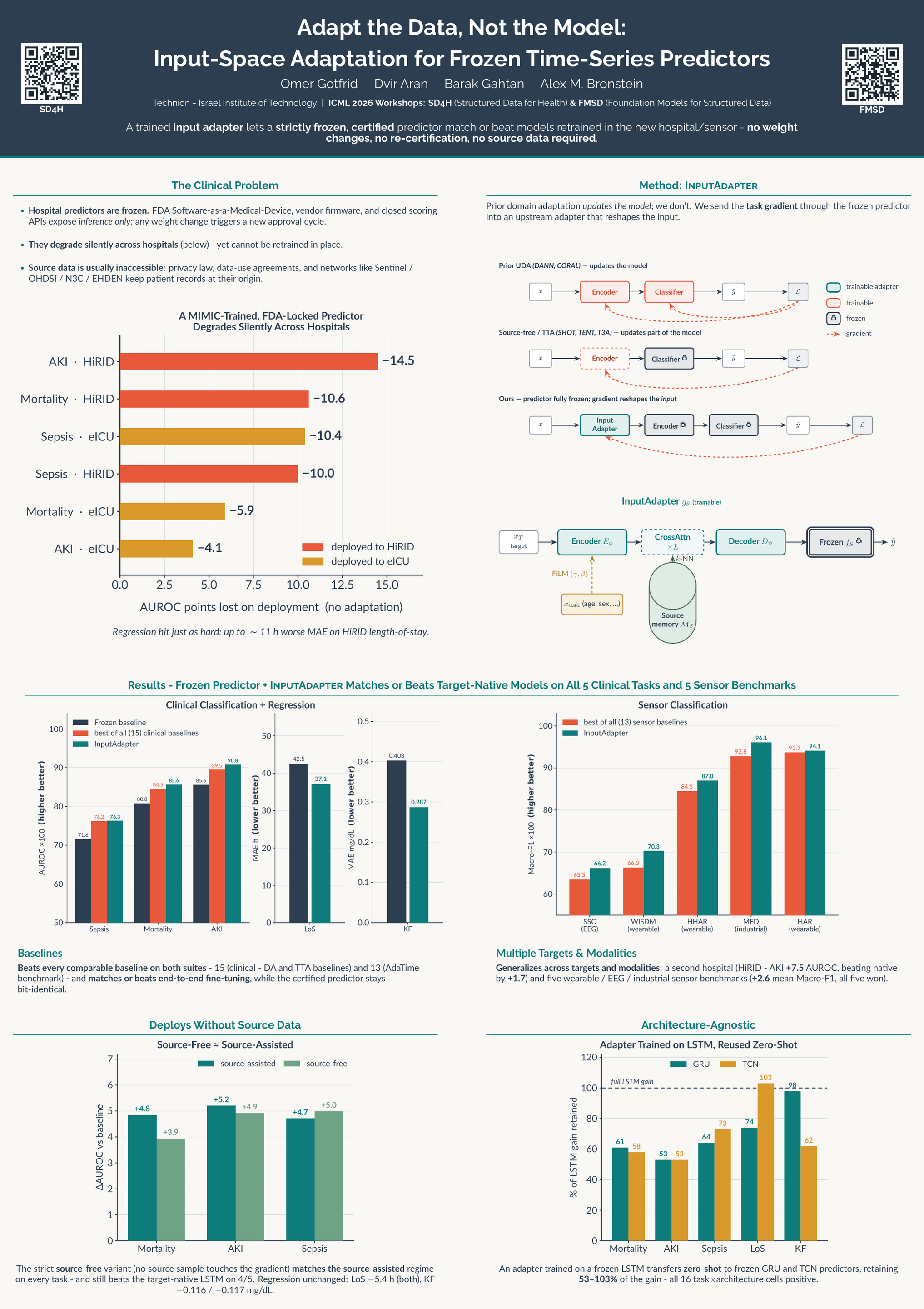
Clinical predictors degrade across hospitals, but regulatory and hardware constraints often forbid changing the validated model. We introduce INPUTADAPTER, an input-space adapter that adapts the data, not the model, while the downstream predictor stays strictly frozen. Most domain adaptation methods assume the encoder is trainable; the complementary regime, where weights are locked but target labels are available, arises in SaMD transfer, firmware-embedded models, and edge deployment, and classical alignment losses cannot propagate through a frozen encoder. INPUTADAPTER is trained to transform target-domain windows into inputs that a predictor trained on the source distribution can consume, without modifying the predictor; optionally, k nearest source exemplars per timestep are retrieved in the encoder's latent space and fused via cross-attention for additional context. Across five ICU tasks (MIMIC-IV adapted to eICU and to HiRID) and all five AdaTime benchmarks, our method outperforms or ties every comparable baseline: four frozen-backbone DA methods, an affine statistics baseline, end-to-end fine-tuning of the predictor, three end-to-end DA methods on the clinical classification tasks, all eleven published end-to-end methods in AdaTime's suite together with two additional strong baselines (CLUDA, RAINCOAT), under the same protocol and five test-time adaptation methods (T3A, SHOT, TENT, SAR, EATA). Our adapter exceeds both the eICU- and the HiRID-native LSTM on four of five clinical tasks, with the largest AUCPR gain on AKI on eICU (+14.1 points).