
Polynomial Input Preconditioning for Zero-Shot Time Series Forecasting
Abstract
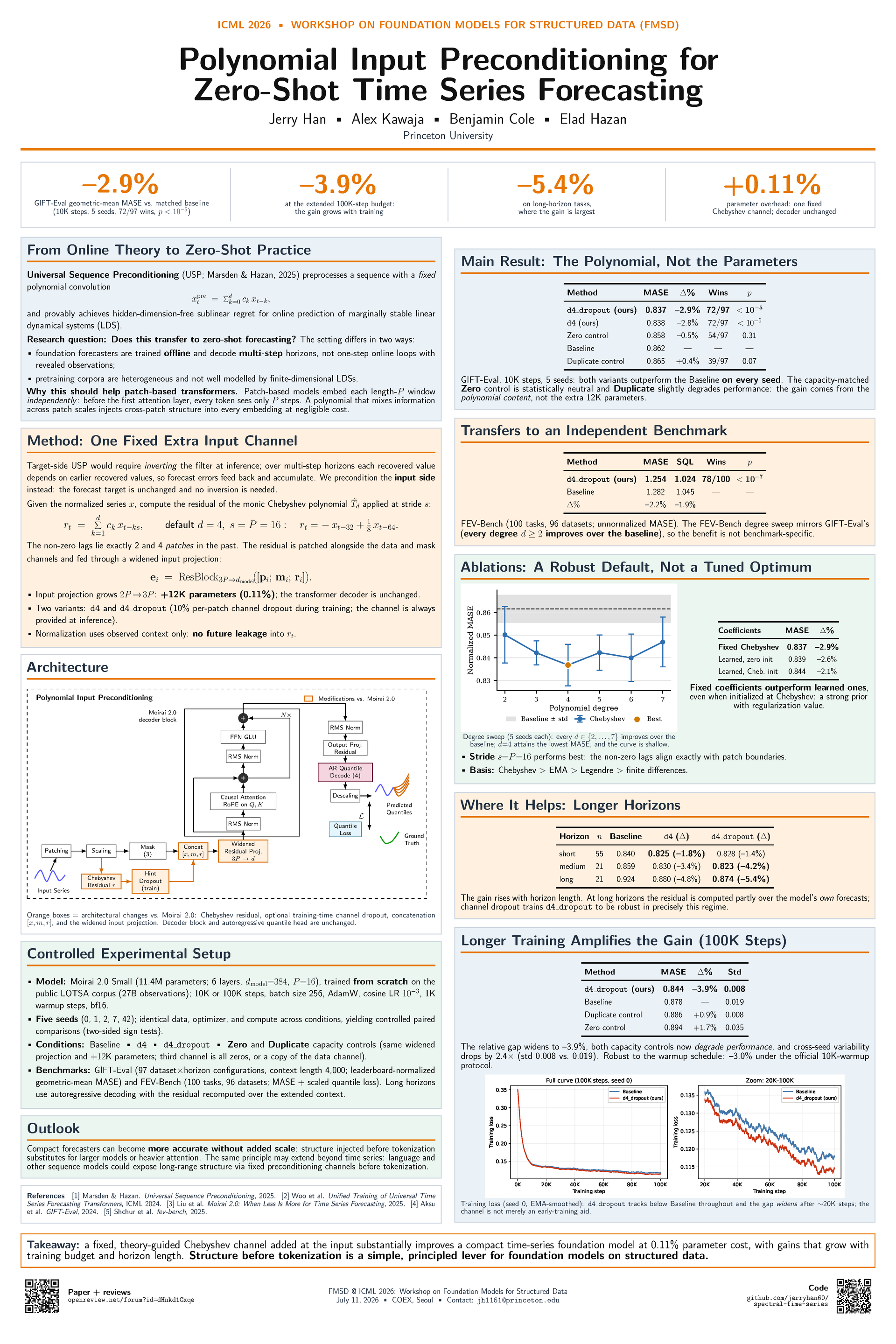
Universal Sequence Preconditioning (USP) is a theoretical framework for online sequence prediction that preprocesses observations via fixed polynomial convolution to achieve hidden-dimension-free sublinear regret for marginally stable linear dynamical systems, and this paper investigates whether these techniques transfer empirically to zero-shot patch-based transformer time-series forecasters like Moirai 2.0. The proposed method, polynomial input preconditioning, concatenates the preconditioned signal as an auxiliary input channel while leaving the forecast target unchanged, adding only 0.11% additional parameters while improving a Moirai 2.0 Small baseline by 2.9% geometric-mean MASE on GIFT-Eval with similar gains on FEVBench. The gains persist at a 100K-step training budget with a larger relative gap and lower cross-seed variance than the matched baseline, and the method performs especially well on longer prediction horizons, achieving a 5.4% improvement on long-horizon tasks. Capacity-matched zero and duplicate-channel controls confirm that the performance gains stem from the polynomial content itself rather than the marginal parameter increase, suggesting that theory-guided structural priors injected before tokenization offer a lightweight path to improving time-series foundation model performance without scaling model size or attention complexity.