
Temporal Feature Extractors in EEG Foundation Models: A Controlled Comparison Including a Pretrained Time-Series Model
Abstract
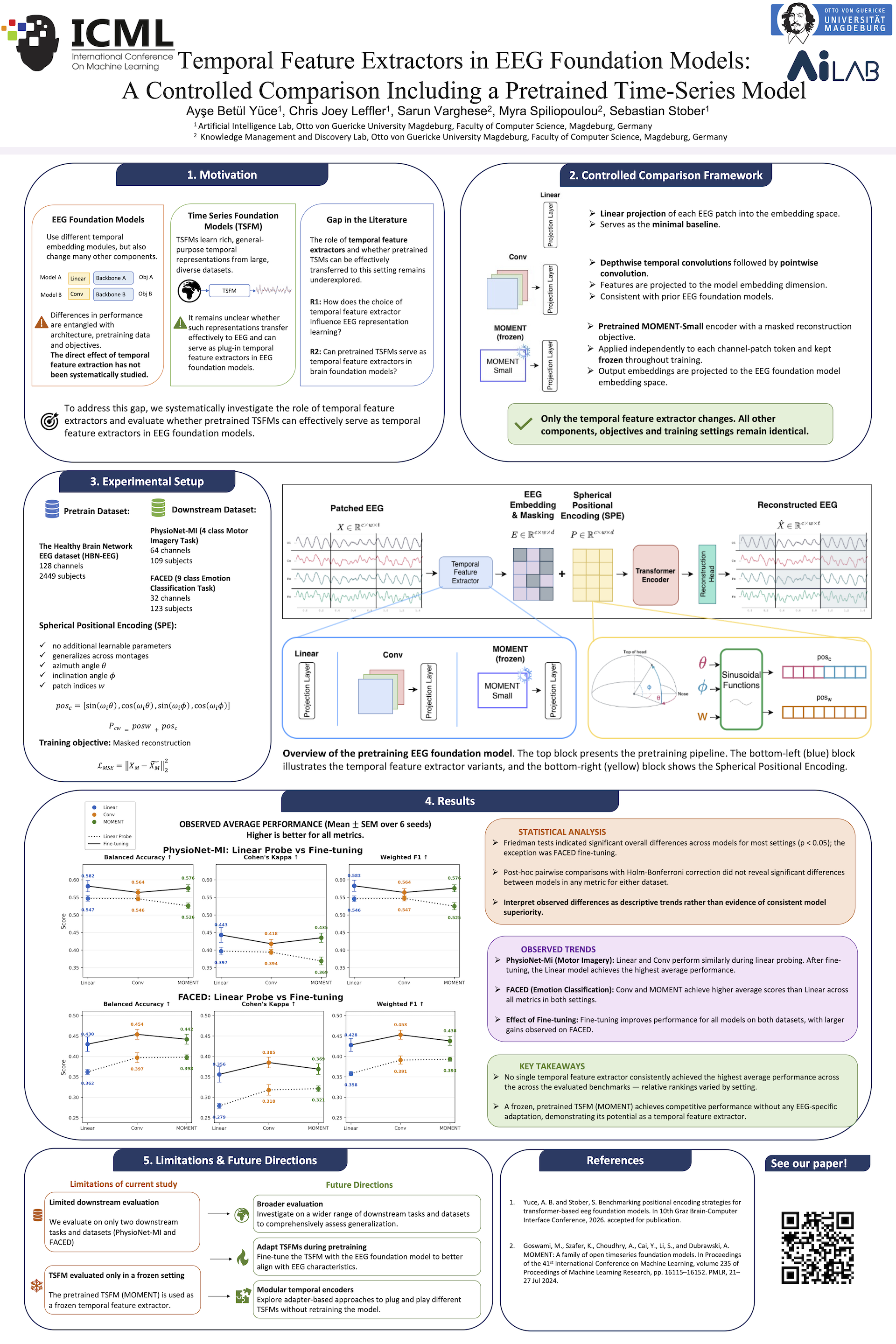
Electroencephalography (EEG) foundation models aim to learn generalizable representations from large-scale brain recordings to transfer across subjects and tasks. However, the role of temporal feature extractors and whether pretrained time-series foundation models (TSFMs) can be effectively transferred to this setting remains underexplored. We conduct a controlled comparison of three temporal feature extraction strategies, including a linear baseline, a convolutional encoder, and a frozen pretrained TSFM (MOMENT), within a unified EEG foundation model. We evaluate their impact on representation quality using two downstream tasks: motor imagery and emotion recognition. Our results show that the effectiveness of temporal feature extractors is task-dependent. While motor imagery can be effectively modeled with simple temporal representations, emotion recognition benefits from more expressive temporal modeling. The pretrained TSFM achieves competitive performance despite not being specifically adapted to EEG, indicating that general-purpose time-series representations can transfer across domains, although the extent of transfer varies across tasks.