
Evolution of Cooperation in LLM Societies : A Multi-Lingual Examination
Abstract
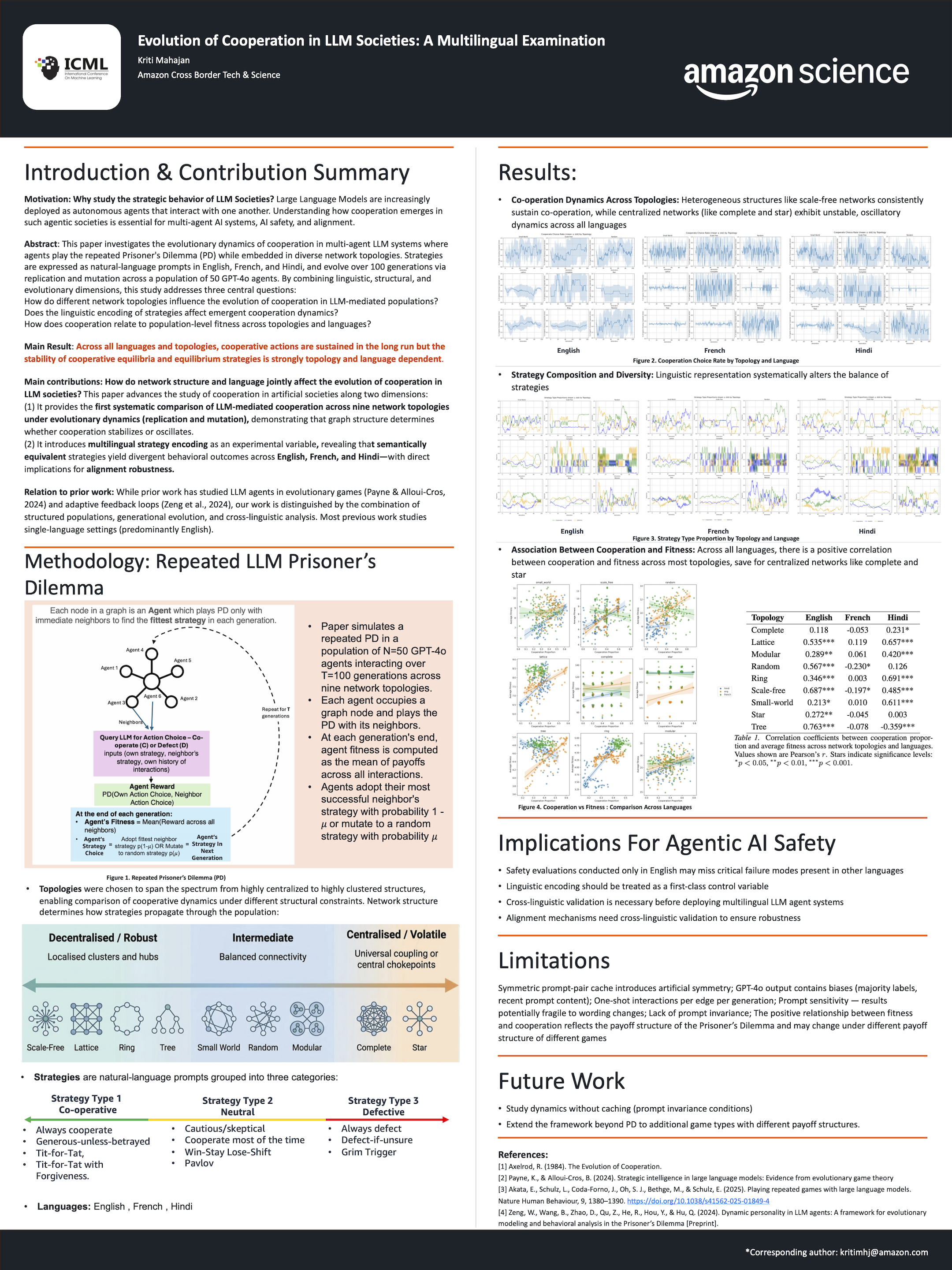
Understanding the dynamics of Large Language Model (LLM) interactions is becoming increasingly important as more LLM systems become autonomously deployed, particularly with the proliferation of agentic AI. We investigate the evolutionary dynamics of cooperation in multi-agent LLM systems where agents play the repeated Prisoner's Dilemma while embedded in diverse network topologies. Strategies are expressed as natural-language prompts in English, French, and Hindi, and evolve over 100 generations via replication and mutation across a population of 50 GPT-4o agents. We find that cooperation persists long-term across all languages and topologies, but stability depends heavily on network structure and linguistic framing. Scale-free networks sustain the highest cooperation, while centralized topologies (complete, star) exhibit extreme oscillations. French networks show the highest volatility; Hindi networks drift toward defection; English networks maintain balanced strategy distributions. A positive cooperation–fitness correlation holds in most topologies except complete and star networks, with strength varying by language. These results highlight critical challenges for deploying multilingual LLM agent systems.