
AgentRouter: Heterogeneous Model Routing for Cost-Optimal Multi-Step Agentic Workflows
Abstract
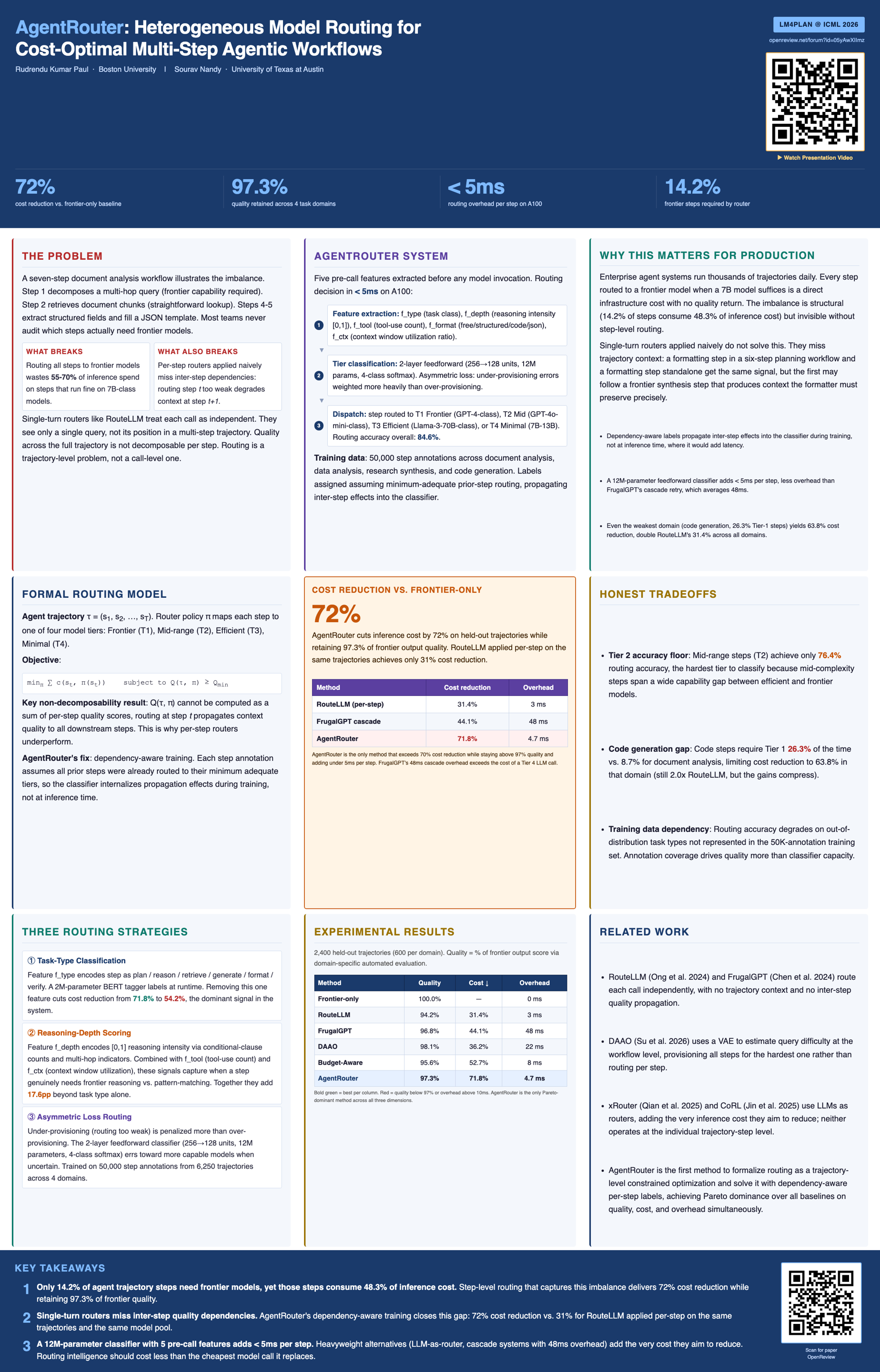
Enterprise agent systems that route every LLM call to a frontier model waste 60–80% of their inference budget on subtasks that smaller models handle equally well. Existing routing solutions optimize single-turn query assignment but ignore a property unique to agentic workflows: subtask complexity varies dramatically within a single trajectory. A planning step may require frontier-class reasoning while a subsequent formatting step needs only a 7B model. We formalize step-level model routing as a sequential assignment problem over agent trajectories and propose AgentRouter, a lightweight classifier (12M parameters, under 5ms overhead per step) that maps each trajectory step to one of four model tiers using five features extractable at routing time. Trained on 50,000 annotated agent trajectory steps spanning planning, coding, research, and data analysis tasks, AgentRouter achieves 72% cost reduction relative to frontier-only baselines with less than 3% degradation in end-to-end task completion. Per-step routing accuracy reaches 91% on minimal-complexity steps and 85% on efficient-tier steps, with 76–82% on the harder mid-range and frontier tiers. On the same benchmarks, RouteLLM and FrugalGPT (applied per-step) achieve only 31% and 44% cost reduction respectively, because their single-turn training signal misses trajectory-level quality dependencies.